Rising From The Ashes / Oriens

From Ascension to Phoenix, Shirley Tang built a world by return.

Shirley Tang has already learned to burn things down. ASCENSION was the foundation. And PHOENIX, the second one, rose from a scrapped collection and two years of evenings and weekends. ORIENS seems to lie between armor and wound, between ancient relic and body as portal. Parsons gave her the framework. Helmut Lang and Marc Jacobs gave the reflexes she had to unlearn. We talked about leather as skin, time as a creative test, and the worlds you keep returning to.

Your work has been worn by figures like FKA Twigs and Amelia Gray. Who, for you, embodies the Oriens archetype at its most precise right now? Not visibility, but alignment.

I feel incredibly lucky that there is a very reciprocal relationship with many of the figures who have worn my pieces. Artists like FKA Twigs, Eartheater, and Kelala have been the sounds guiding the late night hours in the studios before any of my work was public facing, and that is such a precious and affirming thing. I think the most precise embodiment is undoubtedly Twigs right now— I see her in this period of rapid evolution that still remains extremely grounded in the sounds and visuals she has always cultivated. I also love the quote that she loves “worldbuilders” in reference to musicians she admire, and I feel continuously drawn to the world she is creating, which is ever encompassing, evolving, and seductive. I saw her in concert in New York for the Body High Tour with a full stadium and felt this immense connectivity and emotional resonance to her story, and perhaps in a parasocial way this odd pride. This collection was actually optioned for the tour dressing and would’ve been such an incredible way to bring it together, but I loved the looks she wore and hope to have more opportunities to align our worlds in the future.

There is a clear sensuality in the silhouettes you build. What is the core Oriens form? And what is the next distortion of that form you feel compelled to explore?

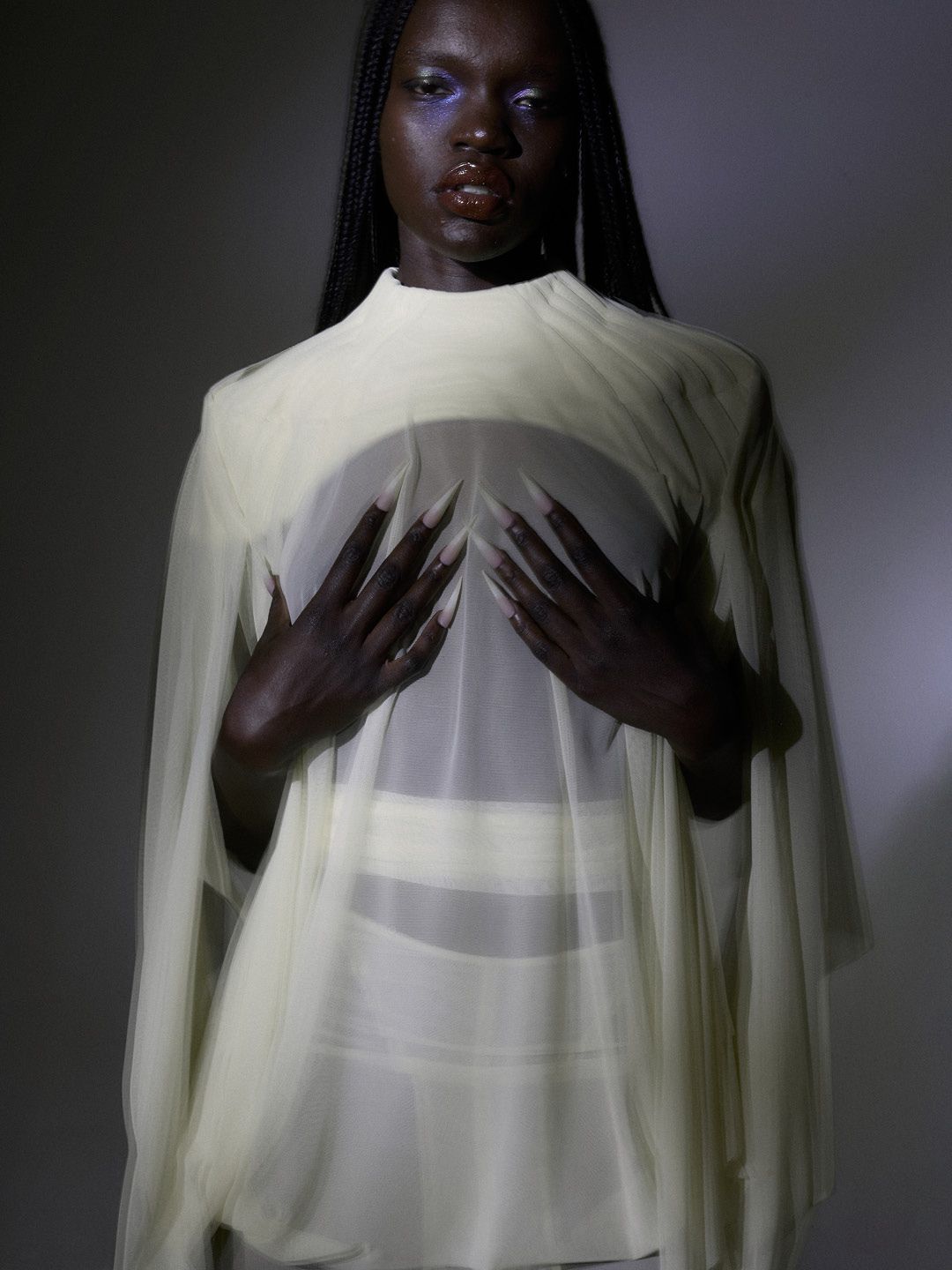
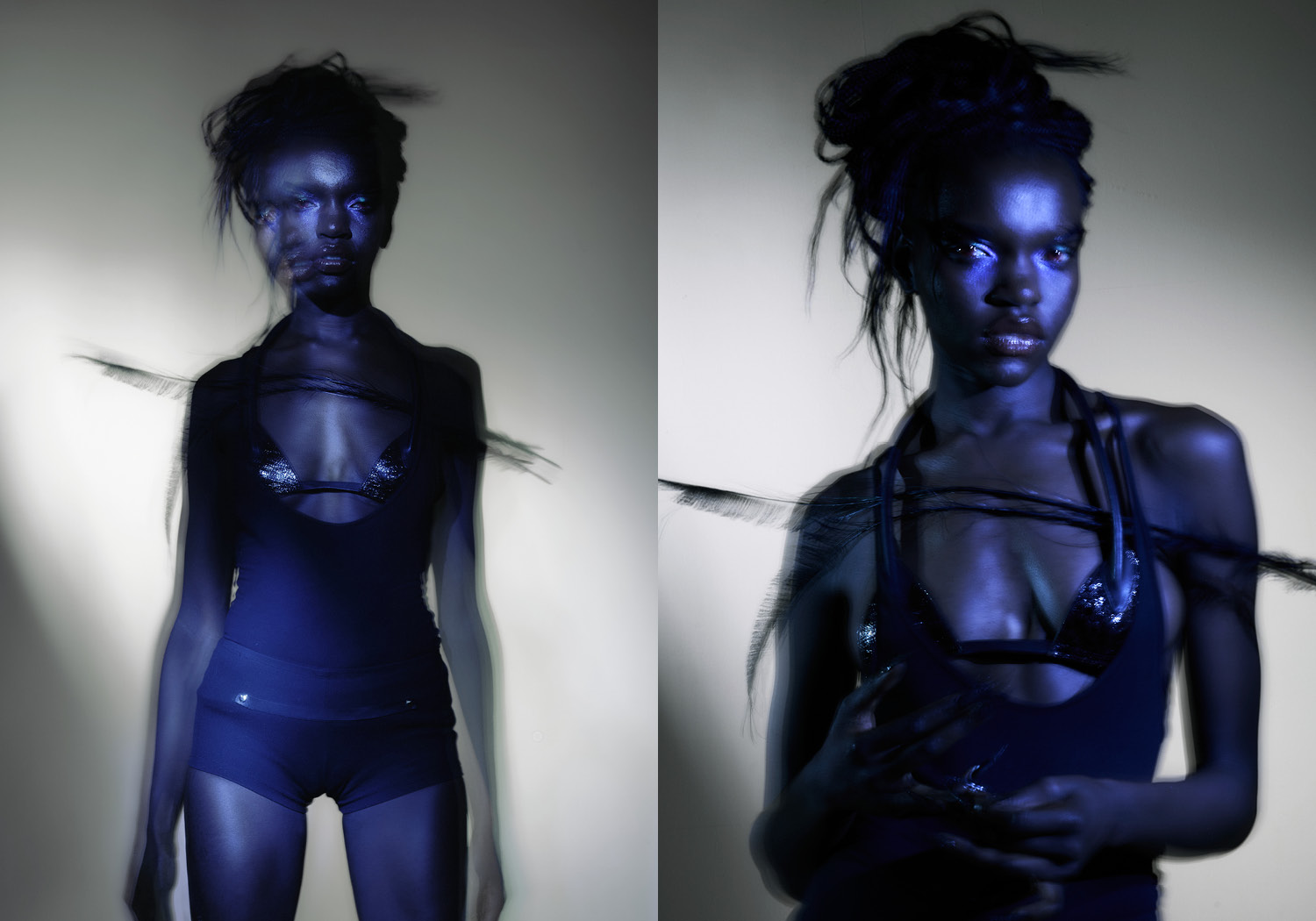
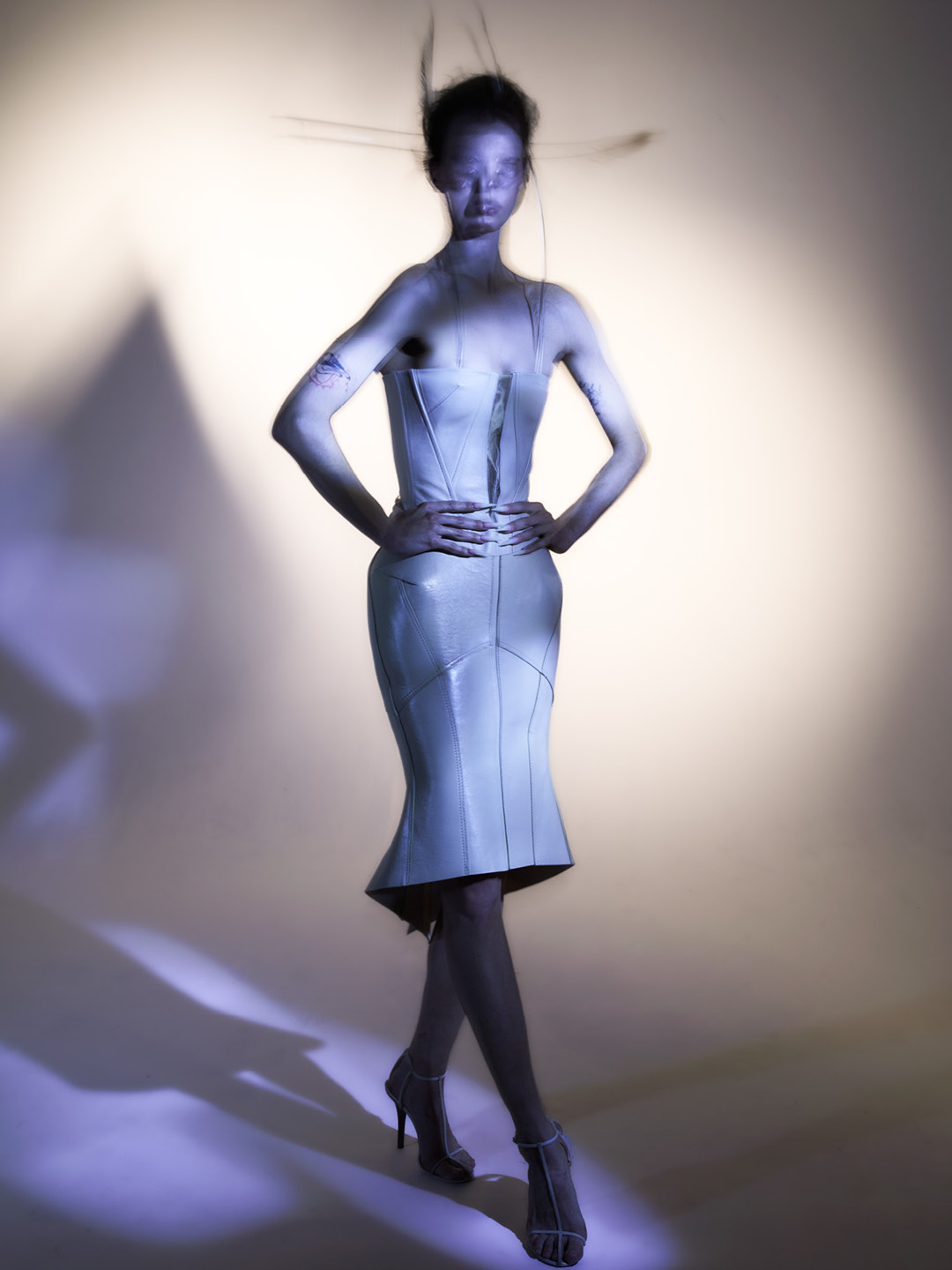
I’ve always felt the feminine form is core to my inspirations and the most important foundation of my work– clothing is to embellish, push forward, and transform ideas upon this basis. I think previously I’ve been very focussed on linear ways to contour the form, but in this collection it’s been very exciting to push it into a more dimensional space, using darts, seaming and material to sculpt in subtle ways that are sensual but slightly more architectural. I’m not interested in majorly distorting the body, rather sculpting with considered precision and subtlety, and this is definitely a quality I want to bring forward in future explorations.

Phoenix pushes further into leather as both material and surface. Beyond technique, what does leather hold for you symbolically? Why does it keep returning?

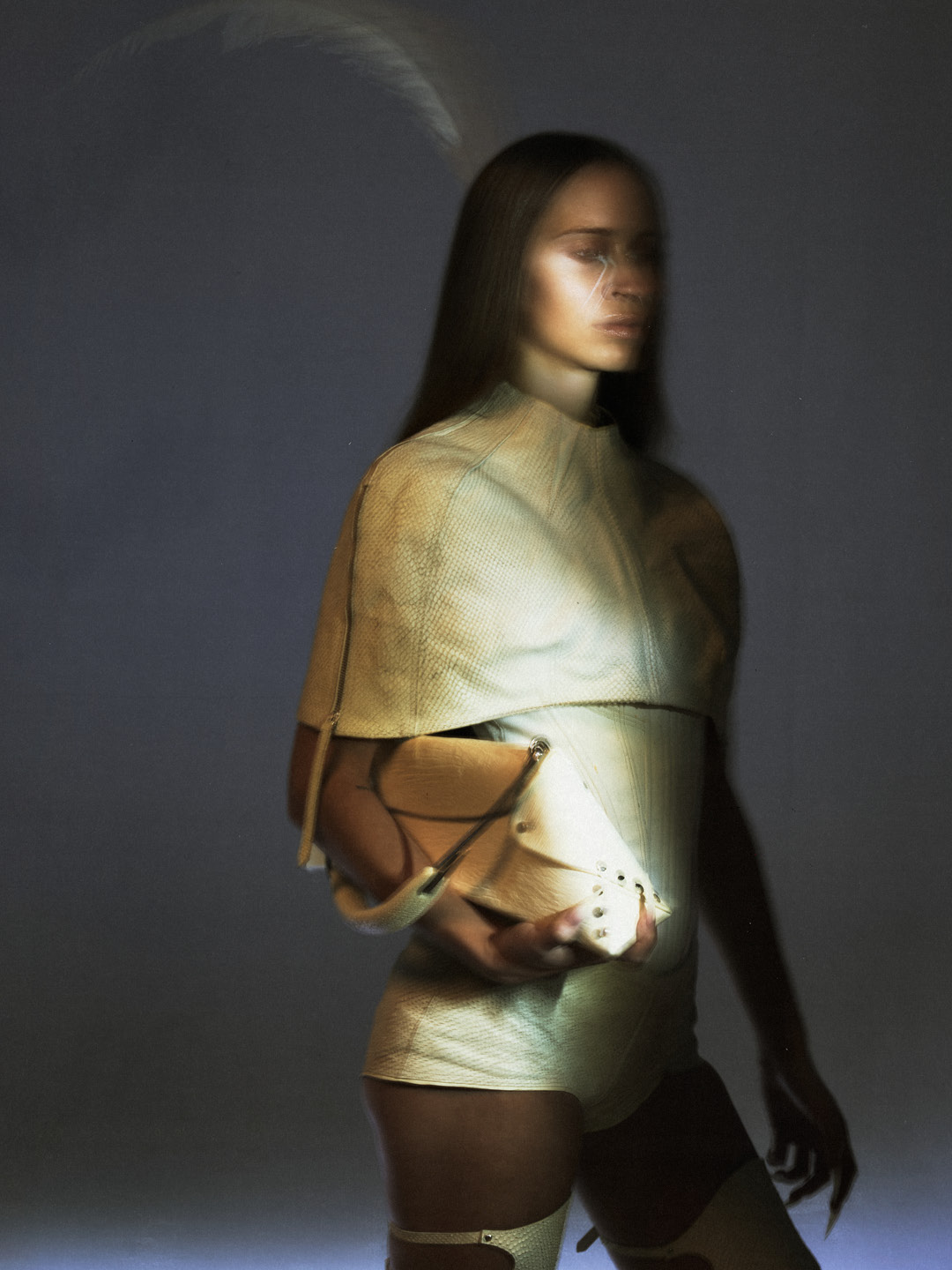
I think leather has this undeniable, inherent sensual quality to it. I think my fascination with it actually started with leather goods and shoe explorations, and falling in love with it as a surface and material with organic possibilities to transform in such endless ways. Of course it has its associations with counterculture and kink, and there is the fact that it is ultimately skin, but I think beyond that it is such a sensorial and inviting material for both a viewer and a maker. I think of “PHOENIX” as an ode to the joy of making and the pleasures of the hand — being such a hands on designer, leather’s unique capability of carrying dichotomies, to become structure or supple tactility, to mold and form or drape, and even its embedded imperfections and variability, is an exciting thing to play with and against.

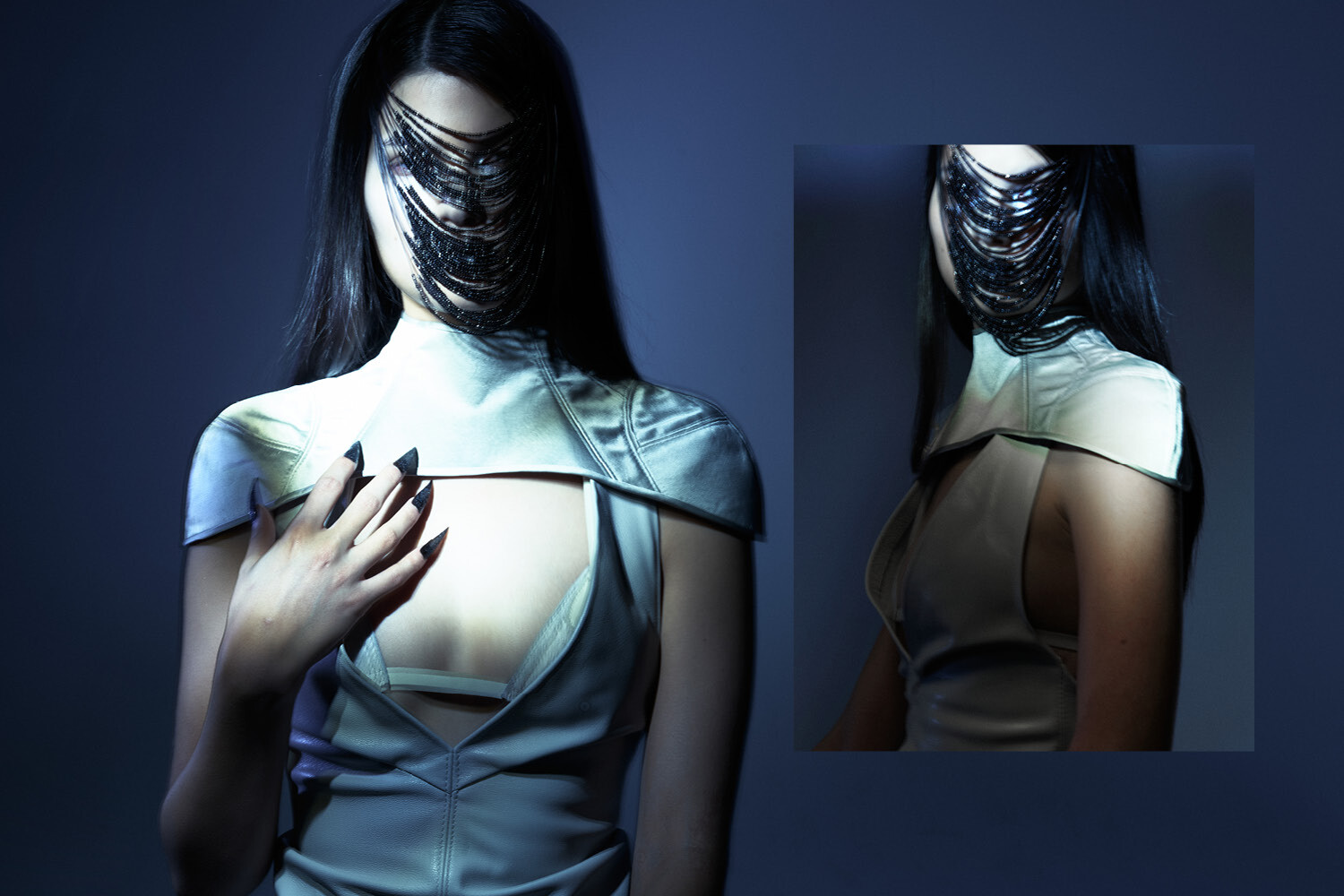
“I’ve always felt the feminine form is core to my inspirations and the most important foundation of my work.”

The collection moves between something ancient, almost ritualistic, and something sharply futuristic. Where are you trying to position the wearer, psychologically? What shift should occur when someone steps into Oriens?

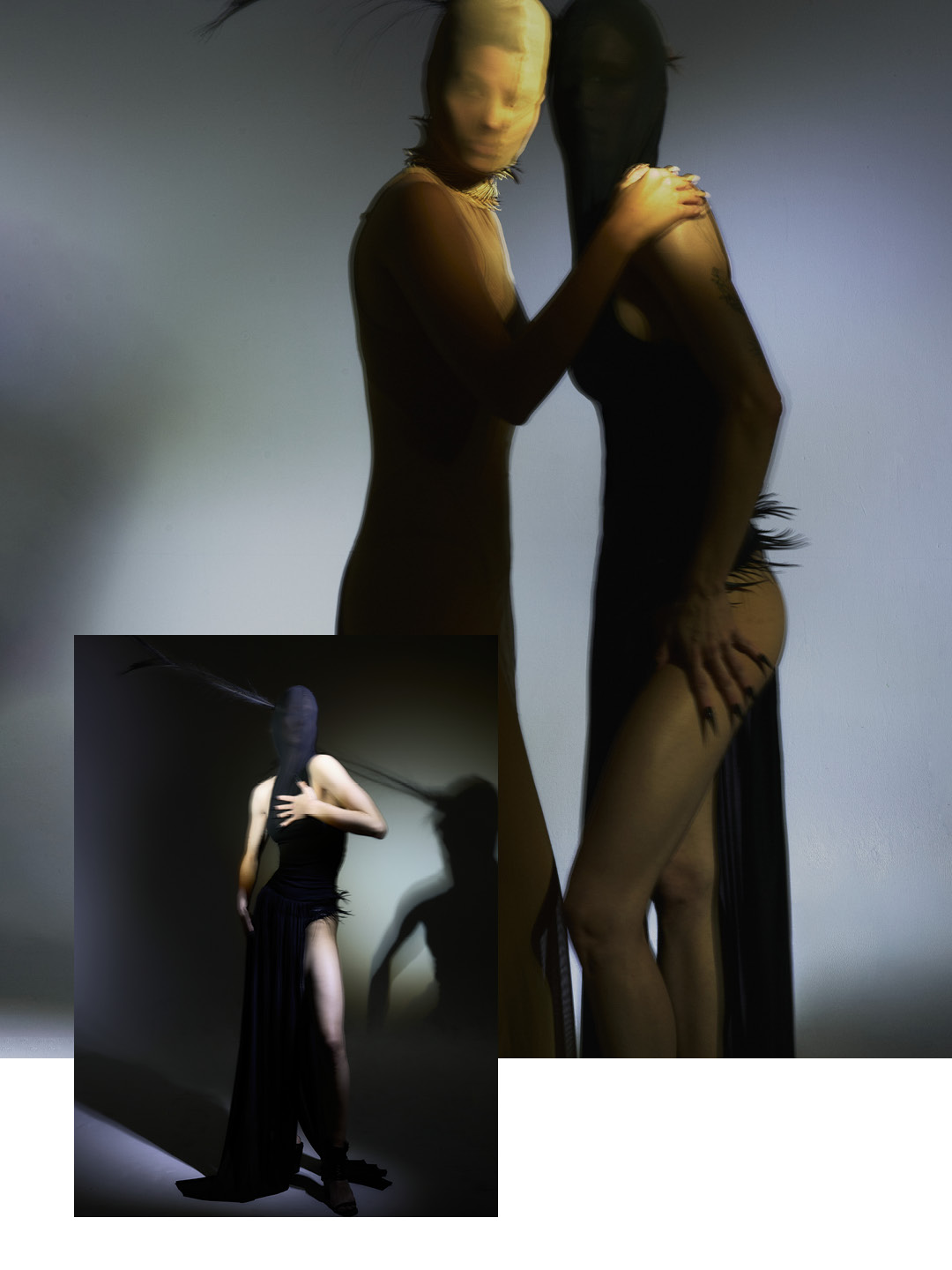
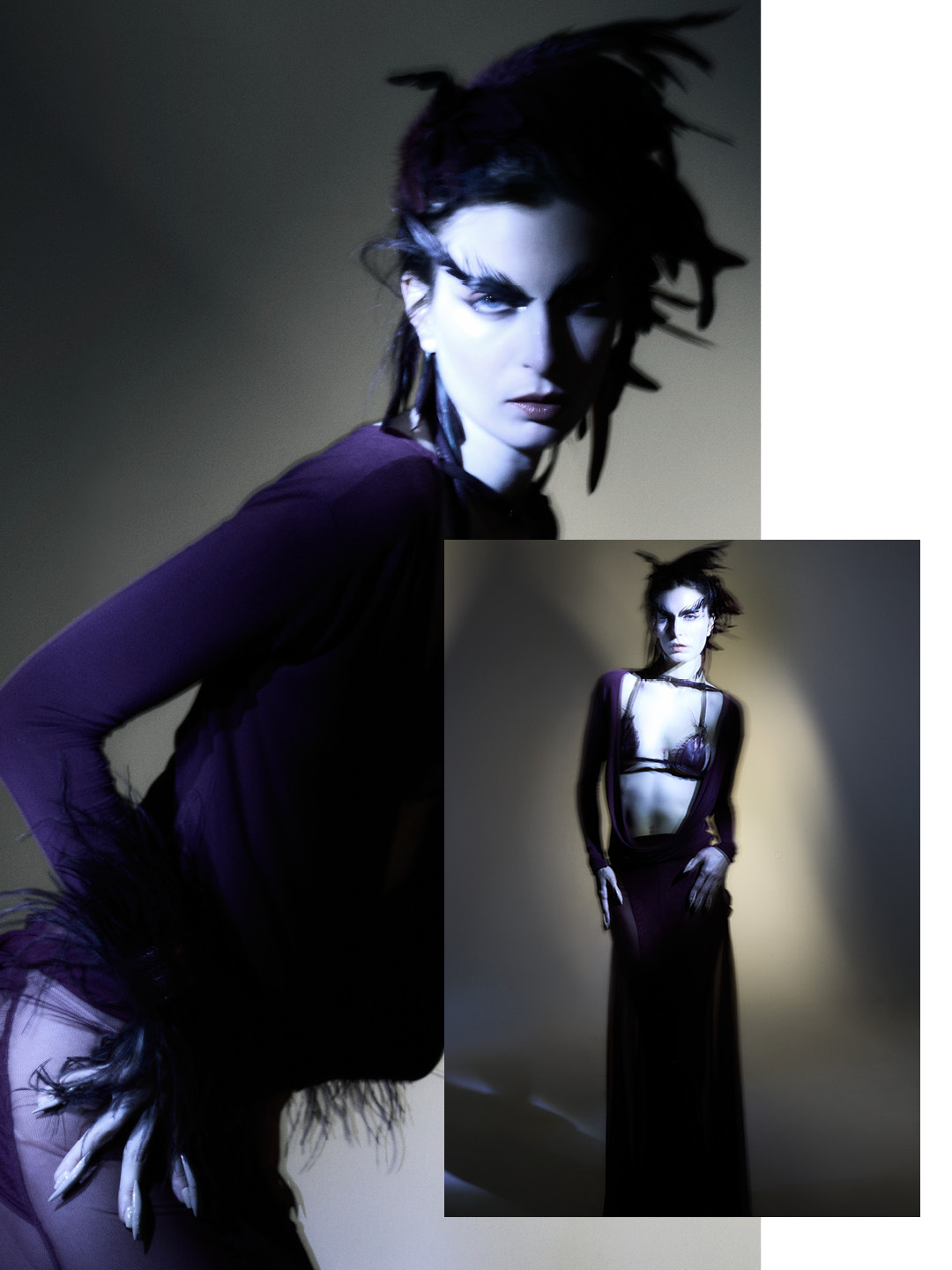
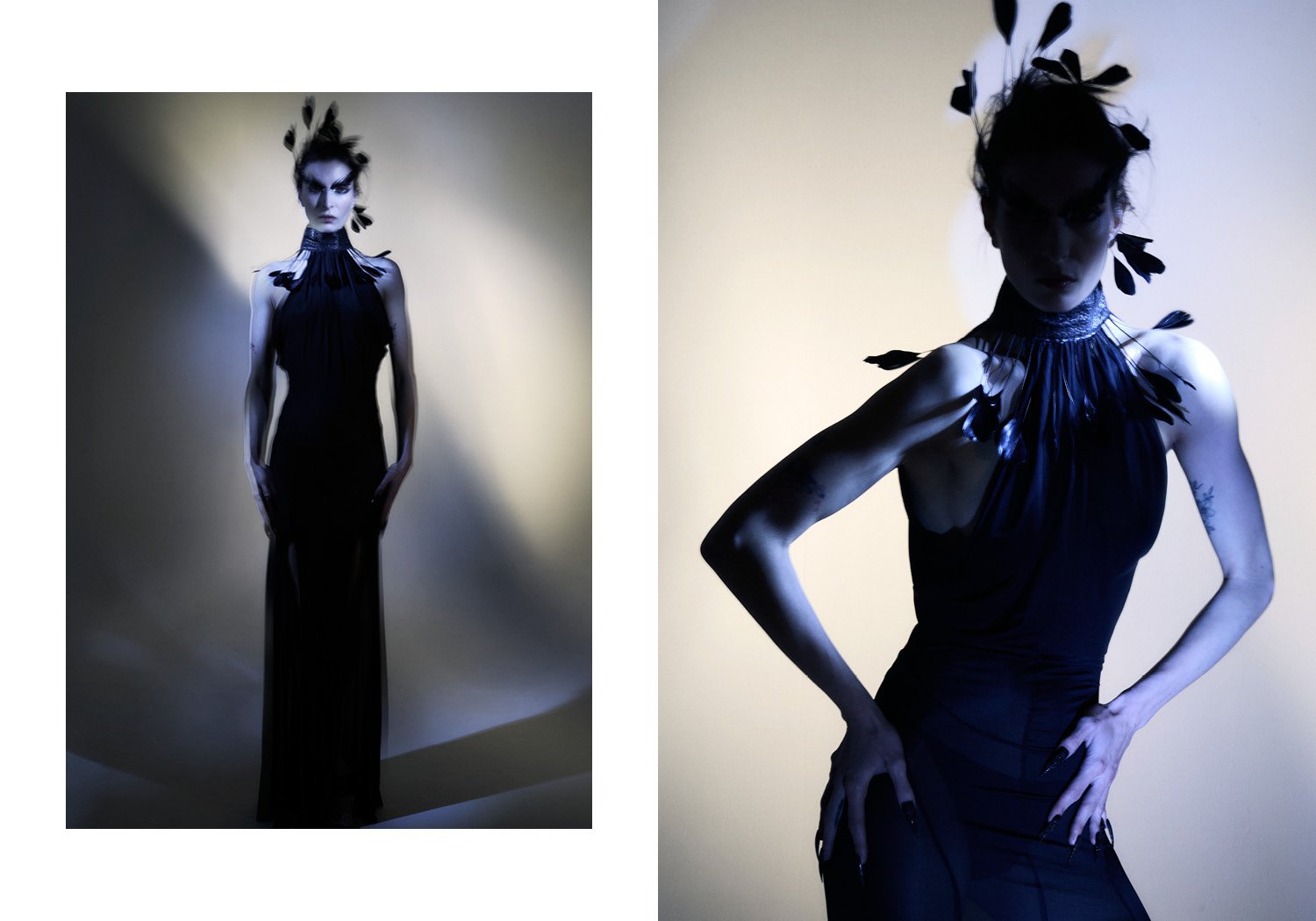
This dichotomy of ancient and future was something I first started really exploring with ASCENSION, stemming from my fascination and research of how ancient relics often coincided in form and design to modern or futurist works, and how the same concept was mirrored in cinema and visual culture. That led me to explore the collection as almost characters in this world, upon the foundation of woman as portal, the body as relic, adorned and revered. In PHOENIX, remnants of that idea are there but in less definitive forms. I love uniting dichotomy and creating something that echoes opposites and defies definition by its multitude, which I think is important to bring into sensuality especially from a woman’s lens.

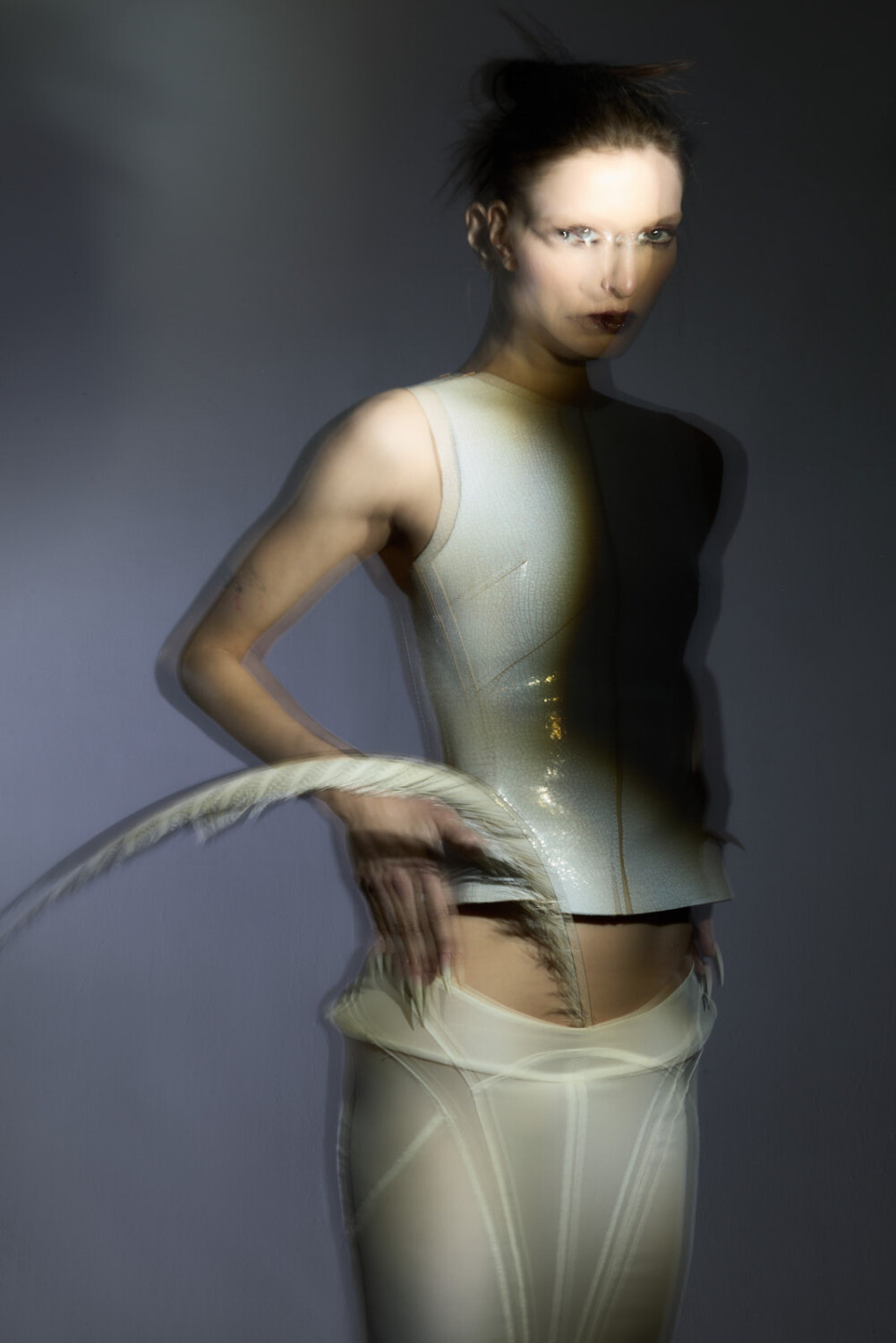
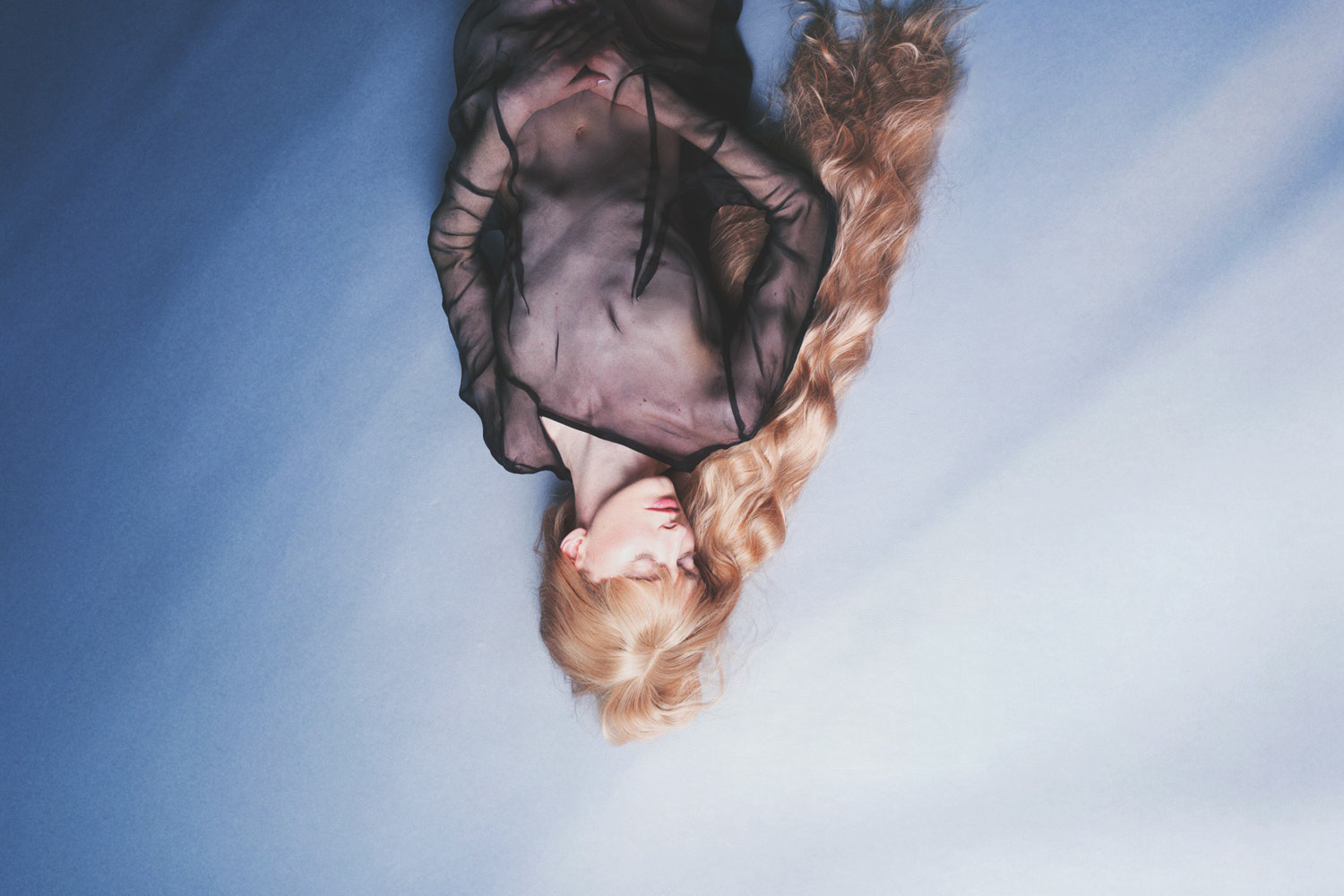
The embodiment of PHOENIX is sensual but strong, feminine but not sweet. Much of the architectural components echo armour, and even the corsets are not designed for distortion but rather sculpturally building outwards to empower strength. Yet within the armor there is vulnerability, leather sliced open to seemingly reveal a sliver of skin through the chest, encapsulating a floating feather. I hope this contradiction carries its own power and feels connective for the wearer, or emboldens them to access this feeling— enchanting in its multiplicity, a performance of sensuality and strength, unafraid to shatter and rise again.

The editorial was developed with James Bee and Joe Van Overbeek. Where did their perspectives sharpen the work and where did you have to hold your ground to protect its original intent?

The process of this editorial reminded me so strongly how important collaborators are to a project. I’ve lived with this collection for about two years on and off, so naturally I’ve narrowed down the work to a specific perspective, which is important but can be narrow and limiting. I’ve been friends with Joe for years but this was our first time collaborating, he initially came on to consult on styling and naturally became such an instrumental force in pushing the collection to its final form. We struck such a great tension upon the basis of openness and respect to be able to question choices and persist where it’s needed. James brought such a willingness and energy to explore the specific photo process I was interested in for the shoot, and the process came together with such incredible synergy and strange perfection. There was this collective energy that was so magnetic on set, when we saw the way the photo process unfolded, the excitement was palpable and audible. It was so special for me to witness and be a part of, to see the ideas embrace something bigger than me. I’m eternally grateful to both of them and the whole team involved for seeing, really seeing, and lending their strength to my vision.

At a certain point, creating stops being about permission and becomes internal. What is the instinct you trust most in your practice? When did you recognize it as something reliable?

I think the process of PHOENIX has shown me how time can be an incredible test of if an idea is reliable, or maybe more aptly resonant. Of course that is a luxury that isn’t often afforded in the pace of the industry, and has its own internal challenges because we naturally evolve sometimes beyond the timeline of development. Ultimately, I trust the initial instinct of clarity when it comes to an idea. The most resonant pieces have been ones that came to be with the most strength and clarity.

You’ve worked inside structures like Helmut Lang and Marc Jacobs. What did you have to unlearn to arrive at Oriens? Not skills, but reflexes.

I think the reflexes of working with a team and for another vision is very different from my process with ORIENS. I really enjoy the differentiation of stepping into an in-house role and transitioning into a mindset and process for a brand which lives almost in its own world of research and contexts, and it allows for a different kind of creative thinking to lend yourself to someone else’s vision and a kind of openness. ORIENS on the other hand is a deeply personal project and very internal, where it is a blessing but also a weight to be the one steering its direction. There have been times where I feel like the containers for these different spaces start blurring, as it does when you’re highly immersed in both, so it has become a mindful practice to recenter when I come into working on ORIENS, and why it has been so important to build this world and foundation for me to always return to.

Do you consider fashion as art or something more operative? What does it communicate beyond image and beyond the body?

I think it is firmly positioned in both spaces. Fashion has the opportunity to explore the boundlessness of art, but in many ways it is grounded by a core interaction with the body. I don’t think it is a constraint per say, but rather something to negotiate, which is important in creative processes. This interaction of garment to body carries so much and I see it as deeply entangled. It is both outwards in the way it shapes image and “performance” of a version of yourself, but also deeply internal intimate because of both the tactile feeling and the emotion it evokes on the body. Ultimately the idea of dressing is ritual, it is performance, and not in a way that it is false or shallow, but a tool to affirm, embellish and manifest outwards.

Outside of fashion, what are you currently obsessed with in a way that feels almost consuming? Not references you translate into design, but something that alters how you see, think, or move through the world.

I’ve been very intent on finding a perfect scent for my home and studio space. I believe really strongly in curating your surroundings in alignment, or as a reflection, of inner spaces. I have a very specific playlist for studio work, for cooking, for meditative practices, and I have a personal scent I love, so I’d love to find a something that mirrors the same sensorial, expansive experience as music is for my work that almost situates you into this space, a marker for entering this world.

What is something about you that doesn’t align with the image or perception of Oriens? A contradiction, a habit, or a truth you don’t aestheticize.

That is such a great question. I don’t know if I have a clear answer to it. ORIENS is so personal to me that it is sometimes hard to distinguish, but I will say that in many ways how I build the personification of the work is aspirational to qualities I desire, maybe a strength and forwardness that I don’t quite possess but yearn for. Perhaps in a way I am seeking proximity, and becoming, through creating.

Rising From The Ashes / Oriens

Credits:

Brand: Oriens / @oriens000 
Photography: James Bee / @beejamest
Design/ Creative Director: Shirley Tang / @shirleytang__
Styling Consultant: Joe Van Overbeek / @joe.van.o
Makeup Artist: Rio Kinoshita / @rio_kinoshita_01
Hair Stylist: Isaac Davidson / @isaacdavidsonhair
Nail Artist: Mami Onishi / @nailsbymamie
Digital Technician: Jacky Wang / @jiaj_07
Gaffer: Weiren Zheng / @zwr_____
Casting: Sophia Scalzo / @_softersoftest
Photo Assistant: Kate Mahoney / @katemahoney
Styling Assistants: Sioxie Val, Sydney Medina / @suzeesval @sydneyamedina
Models: Dia Crosse, Lucy Ly, Jordan Swail, Juju Kujjo / @diacrose @jordanswail @lucylucylucy7 @juju.kujjo
Interview: Ethel Romero / @_bby_ella_

You may also like

Touch The Wood

Fashion | Spotlight
Unveils SS24 Collection and debuts VIBEZ Botanical Gin.

Dremorning

Fashion | Exclusive
Waking up, the edge of the precipice of consciousness. To dream or to live? Which path is worth the risk? See Bocai Chen unravel this idea in this editorial, featuring Xintong Zhu as a model, with fashion by Willow.

Ready to leave

Fashion | Exclusive
Never thought to stay here forever. A fashion story by Amos Haley, styled by Erin Kobrin.