The Last Prophet of Metal / Ozzy’s Exit from the Mortal Rail
Music | Spotlight
In a world spiraling further into synthetic apathy and algorithmic dread, Ozzy Osbourne offered one final scream against the void.

Jessy Frascarelli: You’ve described youth culture as energy rather than generation. What is that energy, actually? Is it affective, social, technological? And what separates it from other kinds of collective intensity for you?
Mark Leckey: Did I say that?
Jessy: Something close to it. But you can change your mind.
Mark: Well, I think I can look back on youth culture as a historical phenomenon that was very particular to the twentieth century. Maybe you could say there was a particular kind of youth culture from the 1950s to the early 2000s. Whatever youth culture there is after that, firstly I’m not participating in it, and secondly I think it was radically changed by the internet. It became something else anyway.
You can put a boundary around a kind of youth culture that belonged to the second half of the twentieth century, post-war and mostly in the West. My influences were America and the UK, so I’ll stick with what I knew.
I’ve become very obsessed with the medieval era, with the Western medieval Christian world, and I think the counterculture that begins in the 1960s is in some ways a revival of the premodern. A return to a different epistemological approach to the world: anti-rational, anti-scientific, anti-modern. It begins with the Beats, with Ginsberg and the rest of it. Interestingly, it begins with poetry. Then it coincides with this rapid acceleration in media technologies, so those ideas can suddenly be broadcast very quickly and very widely. Looking back, I sometimes think of it as this strange millenarian cult which, because of the technology of the time, became a mass movement.
There is obviously an energy before that, in blues, early rock and roll. But the way we now understand subculture and youth culture really explodes in the 1960s. And its energy is teleological. Its energy is at the end. The energy is the year 2000. Everything is moving towards that in the hope that the new millennium is going to bring some radical transformation in politics, economics and culture.
Jessy: It sounds very religious. Are you religious?
Mark: Yes. I’m heading that way.
Jessy: Is that new?
Mark: Fairly new. I think I’ve always been agnostic.
One thing that has helped me think about religion is music. Music was always a means for me to access the transcendental. I always felt that music took me somewhere else, or opened another realm. There was a transference. You moved from one state to another. Music was always spiritual to me. But my background is kind of Marxist, so I used to think of those ideas as false consciousness, superstition. I was never an atheist, but I think my politics prevented me from opening myself to ideas of transcendence and spiritualism. Now I’m old and I don’t care. But more seriously, I think a historical-materialist understanding of the world spends a lot of energy refusing the spiritual or transcendent dimension. Trying to understand the world purely through materialism, through physical cause and effect, means not understanding the whole picture.

Jessy: I also wonder whether the problem is this constant division between nature and culture. We construct these binaries and then act as if one has to cancel the other.
Mark: Yes. I think that very binary thinking is an effect of modernity, and Marxism falls into it too. Subject and object, nature and culture. I think it’s a dangerous dualism. If you accept that there is a material dimension and a spiritual dimension, the world makes more sense to me. It becomes more like a world I actually want to live in. A lot of the frustration with the world now comes from trying to understand it in this purely rational way while the institutions of rationalism themselves are collapsing.
Jessy: That’s what I find strange. We pretend the world is rational while constantly falling into irrationality. Maybe what frightens us is precisely what we cannot see or touch, what we can only feel. Feeling too much forces you to stay with yourself, with your thoughts, with other people. And we are increasingly bad at that. We barely talk to each other, to ourselves, even to what surrounds us.
Mark: Yes. Exactly.
We’d been talking for a while about feeling and instinct, and I wanted to bring it back down to something more concrete: the actual clothes people wore.
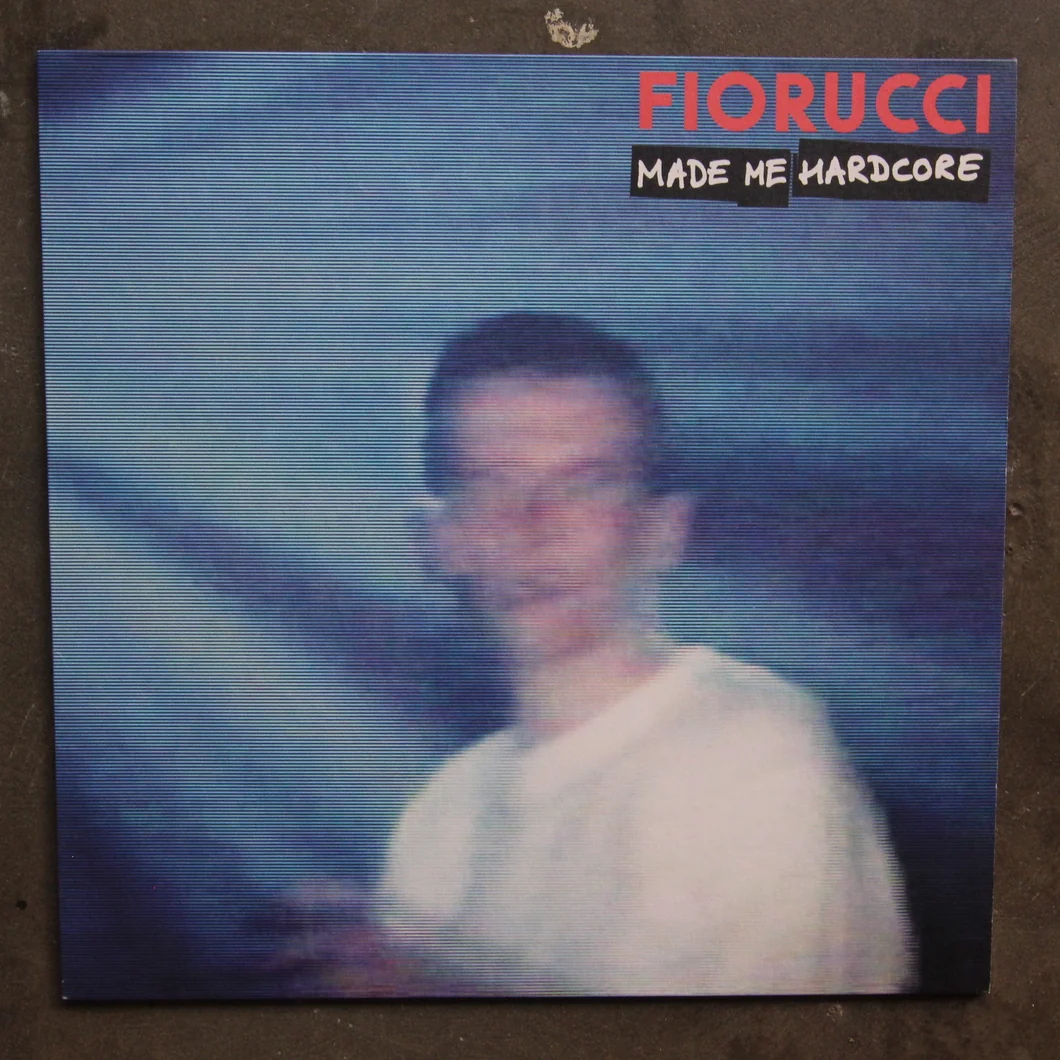
Jessy: In Fiorucci Made Me Hardcore, there’s also this strong sense of aspiration: working-class youth moving through style, music and image towards other possible identities. How central was class desire or social mobility to the culture you were trying to capture?
Mark: That’s a good question.
For me, it’s an expression of a kind of intelligence. A working-class intelligence that expresses itself collectively. It isn’t top-down. It’s an emergent property of a local intelligence. I know that from lived experience. In the 1980s, I was what was called a scally or a casual. And it was very aspirational. It was the beginning of Thatcherism and suddenly all these luxury goods were becoming extremely visible.
Before that, those brands were really concentrated among the rich. Film stars had Gucci bags. You wouldn’t even necessarily see those things among the middle classes. Then there were more magazines, more advertising, all this stuff appearing. As young working-class boys, we saw it and recognised its potential as a manoeuvre.
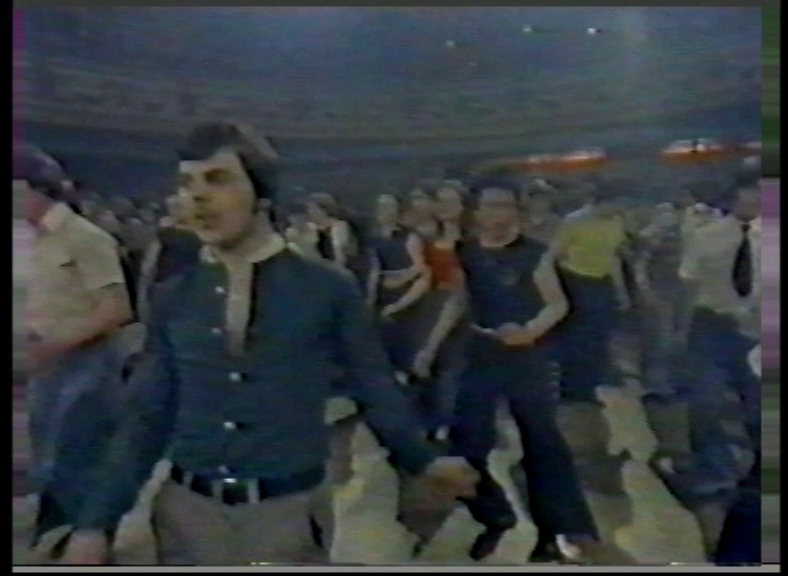
At football matches, the police were looking for skinheads. That was the image they associated with violence. So part of going to football became not getting noticed by the police. If you wore clothes that weren’t meant for you, clothes belonging to a completely different social class, you confused them. In some ways, you became invisible to them. That’s what I mean by collective intelligence. It wasn’t one kid who suddenly turned up wearing these clothes and everybody copied him. These things appeared across a city, in different pockets, among gangs that sometimes didn’t know one another. Almost virally. Then you would arrive at the match and see each other. The codes became visible. They were understood and developed collectively. You can apply that to all those twentieth-century subcultures that were essentially working class: punk, mods, rave.
Journalists continually try to discover where something began, who the originators were. There might occasionally be one or two people you can point towards. But it’s always a collective effort. Always a community effort. That culture still exists in different ways. You can see it in grime. Here in London you have roadmen, young guys dressed head to toe in black sportswear, North Face and so on.
Style was one way of tracking that intelligence in the body. I wanted to know what happens to it once the body actually starts moving.
Jessy: There is another thing in your work that interests me: the point where the individual body stops belonging entirely to itself. Especially on a dancefloor. What were you looking for when you were dancing?
Mark: When I listen to music, I’m transported by it. It opens this sonic landscape that I can enter into. But what I remember about really dancing, when I was raving, taking ecstasy and acid, was wanting to reach a particular state. I don’t even know if it was completely enjoyable. It was very cybernetic, very twitchy. Especially with acid house and jungle, it felt as if the music was puppeting me. I was a puppet and the music was making me dance. That was the state I wanted to achieve.
Jessy: Almost being automatized.
Mark: Yes. Exactly. Being automatized by music. That’s exactly what I wanted. Part of me also wanted to feel slinky and sexy, and occasionally I probably managed that. But mainly it was this other thing. And obviously it had to do with the music. Early acid house isn’t particularly sexy music. It’s intentionally robotic, automatic. That question of losing yourself stayed with me, and it made me think about how he tries to hold onto it afterwards, once the night is over.

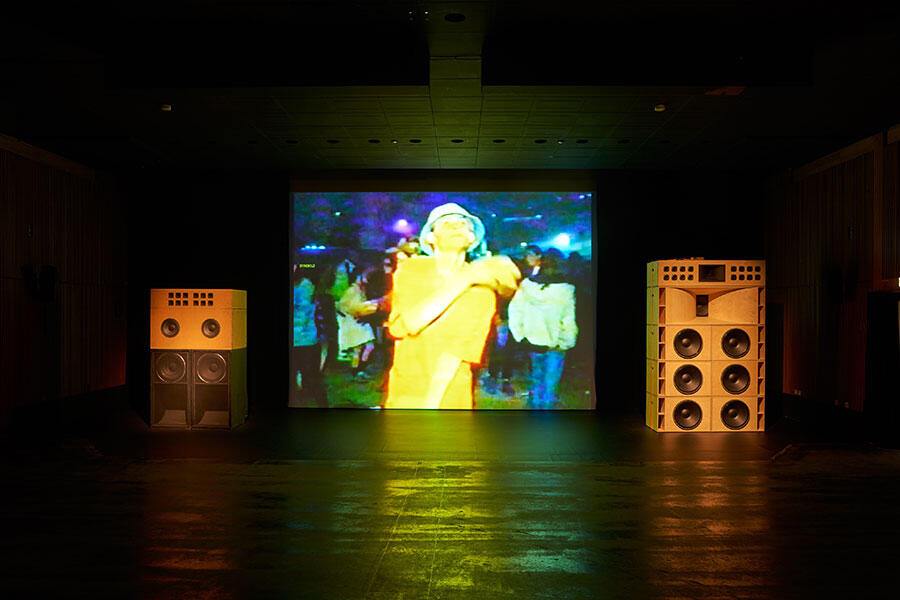
Jessy: Your work often suggests that recorded media can carry traces of lived intensity. Do you experience archival footage more as storage, transmission or reanimation?
Mark: I have to think about that because I’d say it’s almost been a historical process for me. I’ve probably gone through all of those ideas about what a recording is. But I don’t know if I do any longer.
At the moment I’m trying to make something. I intended it to be a video, but I’m finding it difficult to muster enthusiasm for moving images. Whatever charge they once had, whatever energy was contained in them, seems to have been diminished by their ubiquity. Watching videos every day on Instagram has probably diminished their power. They feel slightly depleted. And then I’ll find one little clip that reanimates me, makes me excited again. So I’m struggling with that at the moment. I can’t quite articulate it yet.
But when I began Fiorucci in 1997, it was all archival material and that archive was incredibly rare. There was scarcity around those videos. Part of the excitement of making the work was finding these hidden recordings and documents and reassembling them. Then the next video I made like that was Dream English Kid, around 2015. The idea there was almost the opposite. Could I make an autobiography out of everything that was online? There was suddenly such abundance. Within this enormous archive of video, could I assemble something that seemed like my life, from childhood to adulthood? Now I’m trying to make something again and abundance isn’t even worth commenting on anymore. Now I’m in the realm of AI. I’m in the realm of the prompted image. So it’s very different.
Jessy: Do you think forms of collective immersion comparable to pre-digital rave culture can still exist? Or has smartphone mediation fundamentally changed the way shared intensity works?
Mark: I think we’ve already touched on that. Things have fundamentally changed.
Jessy: Then let me put the last two questions together. If you were beginning to engage with youth culture now, where would you look for that energy? What scenes or gatherings would interest you? And at the same time, your work often seems suspended between past and present. Does youth culture create a temporality of its own?
Mark: I’ll try to merge those. I have a monthly show on NTS. I’ve been doing it for about eight years. When I started, I just played old music that I already knew and owned. Very quickly I exhausted that. So I had to start looking for new music, and that really changed how I listen. I had to find the conversation that would allow me to discover where music is. Because I wasn’t young anymore, it wasn’t immediate to me. I had to go and find it. Eventually I did.
There’s a type of music I’ve been playing for the last four years that I really like. I still don’t know exactly what it’s called, but it’s somewhere around SoundCloud rap. As soon as I heard it, I thought it was really exciting because it sounds like someone trying to impersonate the internet. It has a sound that could only have come from the conditions of the internet. It’s completely digital in that sense. Now that music has become much bigger. I listen to things like Fakemink and SD Kid. It’s not completely overground, but it’s big. And when you look at those concerts, the energy is amazing. So although I’ve said you don’t get youth culture in the way you did in the twentieth century, those gigs seem very close to it. The enthusiasm, the charge. There is definitely music out there that has that energy. It’s simply harder to find. Less visible, somehow. As for past and present, I think about that mainly because I grew up in an analogue age and then witnessed the transformation into the digital age. That pivot was enormous.
As an artist, it’s an incredible moment to have lived through because it gives you this extraordinarily rich material. We’re shifting from one kind of episteme to another. And I can feel that change. I can track it in myself, in my body, in my mind, in my children, in everything. I’d been at art school for ten years before I made Fiorucci, and I hadn’t really made any art because everything felt too remote, too intellectual. Then I realised I could make work out of something I knew. Something I had directly experienced. That’s what woke me up as an artist. I didn’t have to make work by trying to understand discourse or critical theory. I could make it from lived experience. And that is still how I work.
For me, the most salient point of my experience is this massive rupture between the past and the present. Maybe everybody feels that in every generation. But I still think it’s an objective truth. If you’re old enough to have known what it was like to live in the analogue age, this age has upended every kind of value that existed before.

He says all this without much nostalgia, which is what makes it land. Leckey isn’t mourning the year 2000 or asking anyone to bring it back. He’s naming a fact, the way you’d name a scar. Whatever comes next will have its own energy, its own people finding each other for reasons they can’t quite explain. He just won’t be the one telling us where to look for it. He already had to go looking himself, for years, before he found it again in a sound he still can’t name.
Credits:
Artist: Mark Leckey / @mark.leckey
Words: Jessy Frascarelli / @j3ssyestremy