Lockdown diary #05
Photography | Spotlight
Michelle from New York, USA.

I’ve always been good at hiding. It’s stronger than me. I don’t know whether to call it a natural talent or something else entirely. What I know for certain is that if I have to choose between dark and light, I pull the first one close without thinking. Actually, I wouldn’t even call it a choice. It’s predisposition. Habit. Or, why not, survival. People have always looked at me. They still do. And now, at this age, with this kind of clarity, I understand what people mean when they say a look is worth a thousand words especially when, throughout childhood and adolescence, those looks were inquisitive, sad, confused, angry, troubled. Looks I didn’t seek for answers. Only for something simpler and rarer: understanding. Acceptance. Love. Until I realized they had understood my difference before I had.
I don’t know if any of you have ever been to PAC in Milan. What separates the ticket desk from the exhibition space is a red curtain. So, before I’d even gone in, while I was buying my ticket, it was my ears that moved first, not my eyes. From beyond that curtain came Il cielo in una stanza by Mina, on loop. At first I just listened, it’s one of my favourite songs, without asking myself what it was doing there. Only after stepping through that curtain did I understand. I understood I would never hear it the same way again. I understood that for years I had listened to it without really hearing it. And I never could have imagined that a song could hold an entire world inside it. Let alone that a photography exhibition could shake me the way this one did.
There is a microphone. It stands there, still, in front of a screen. On the screen, a woman is singing. The microphone is outside, in the museum, in its deafening silence. It isn’t connected to anything. It’s just there. And if you know the lyrics, if you actually stop and listen instead of letting them wash over you, you understand that song wasn’t chosen out of nostalgia or aesthetics. It was chosen because it’s exactly what the whole exhibition is about. The room that becomes sky isn’t absolute freedom, it’s conditional freedom, existing only inside certain spaces, only with certain people, only when someone chooses to truly see you. The voice has always been there. The microphone, though, has always been missing.
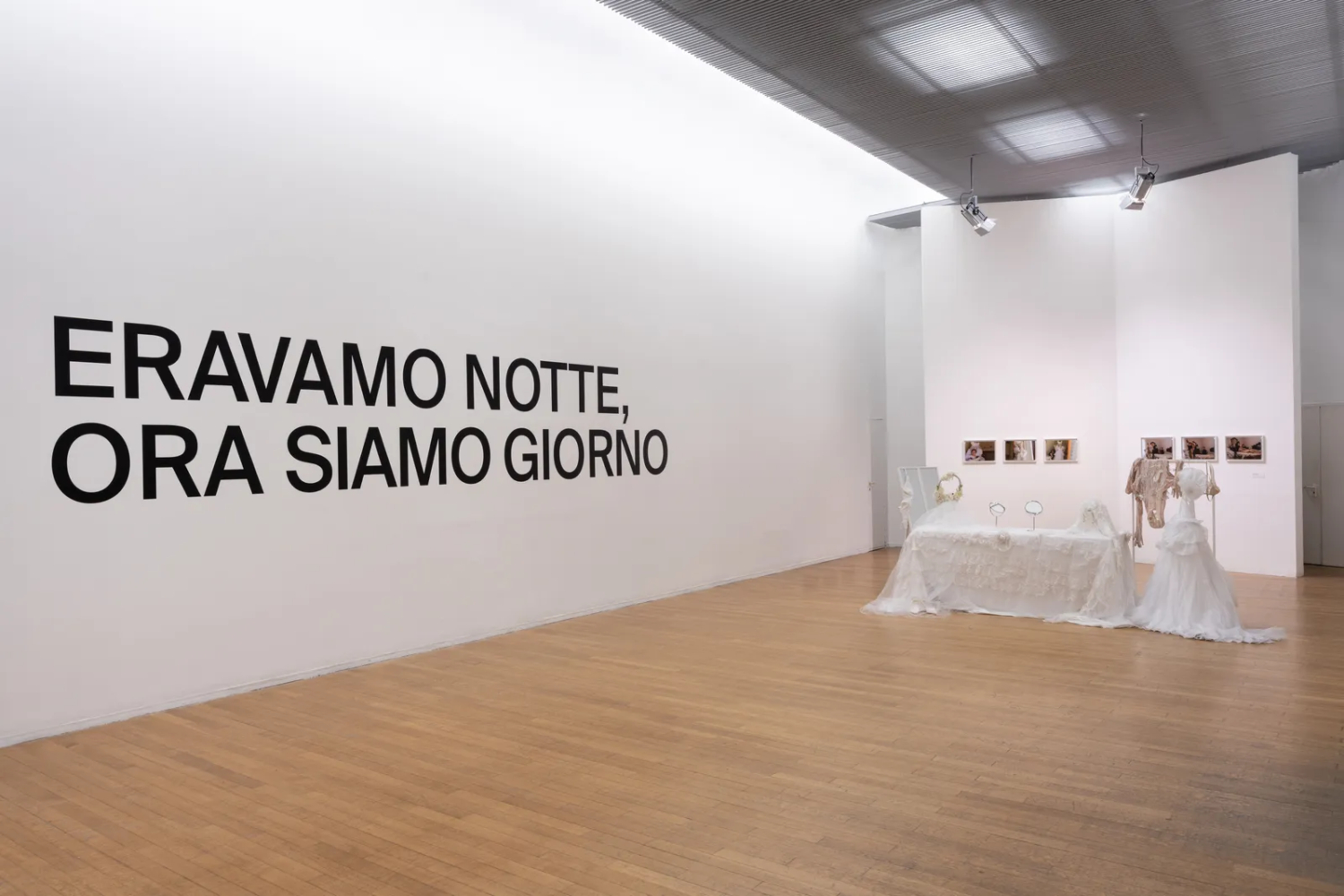
“Eravamo notte, ora siamo giorno” by Ambrosia Fortuna brings together over ten years of photographs and videos made between Milan and Naples, inside the Italian queer and drag scene. Ambrosia never looked at her community from the outside. She came to Milan at twenty- one, became part of that network, and photographed from within. Her images are born out of necessity. You feel her need to give back to her sisters the voice that belongs to them. The gaze of someone who has lived certain things on their own skin is not the same as the gaze of someone who only watched from a distance.
And that’s what stayed with me throughout the exhibition. The sisters in the portraits look into the camera. They look at the lens. They look at you. It isn’t the pose of someone who wants to be immortalised. It’s the gesture of someone who knows they will be looked at, who has always been looked at, often in the wrong way and decides to look back. I see you looking at me. I know you see me. I’m used to that fraction of a second in which someone decides what you are before you’ve even opened your mouth. But I’m here. And I’m looking back at you, because I exist, and I deserve to as much as you do.
You move through two territories that are in constant conversation: night and day. Not just as metaphor, physically too. Like moving from one side of the same life to the other. Fragments that seem unconnected until, stepping back, you see they’re complementary. Night and day: dissimilar on the surface, incapable of existing without each other.
The night is what you’d expect from an exhibition about the Italian queer community. The clubs, the dressing rooms, bodies in transformation, drag queens backstage, friends at five in the morning. Night becomes the dreamlike space where you can be who you are, even if only for a few hours. And where better than the clubs, which have always sheltered an identity and sexual freedom that the rest of the world barely grants, and only on certain terms. The night is a space of appropriation, of exhibitionism, of breath. For these people it was never just a time of day. It was an institution. A place where you didn’t resist, you existed, simply, without having to justify anything to anyone. Before visibility, there was the night. And here the gaze is shared. Happy, carefree. Together in one place, one collective exhale of relief. A gaze that’s open, relaxed, because in this case there is strength in numbers.
Then there are the daytime photographs. And those are the hardest. Taken in homes. Natural light, domestic environments, intimate spaces. It looks like the territory of freedom: your own home, your own space, nobody watching. And yet homes are often the site of the most ferocious, most silent conflict. They’re the places you return to after the night and stop being who you were just minutes before. The tables where you eat in silence because nobody knows how to speak. The rooms where children are still figuring out who they are and parents have already decided what they’re allowed to be. That domestic light is also an act of reclamation. This sofa, this kitchen, this window looking onto the courtyard, these are mine too, in daylight too, even when there’s no club to take me in. And in the daytime photographs too, those people look at you. Same gaze. Same steadiness. Reclaiming daytime space is no less political than reclaiming the night. It’s just quieter, more daily, harder to sustain without a community around you.
There’s a tension in the title worth sitting with. Eravamo notte, ora siamo giorno sounds like a declaration of victory. In part it is. But daylight has a cost, and the exhibition doesn’t hide it. Becoming visible also means becoming classifiable. Labels, such as queer, drag, trans, non- binary, are born in daylight, in the language of people who have never lived them but use them to impose order on what they don’t understand. They become cages when applied from the outside, when they crystallise into a category what is actually a process. In Ambrosia’s photographs you see people in dressing rooms, in waiting moments, in domestic scenes, before the label. There’s no category there. There’s only someone getting ready to exist. Pride month amplifies voices, brings into the streets what for decades stayed in clubs and kitchens at five in the morning. It’s necessary. But a question remains open, felt in every step through these photographs: has becoming visible in daylight freed us, or just moved us into a larger room where you can still see the walls?
I go back to the microphone. Back to the screen, to the woman singing, to the voice that fills a space it cannot leave. And I notice a detail I’d missed before. She is the only person in the entire exhibition whose gaze isn’t directed at the camera. Only by connecting this gesture to the song do I understand. Il cielo in una stanza is about a transformation that depends on the presence of another. The room becomes sky because someone is there with you. Because they see you. Because they choose to stay. And here it’s me who chooses to stay, even though the gaze isn’t returned. I watch her. I admire her. For the first time in the whole exhibition, I’m the one exposed. Not her. After everything I’ve seen, after all those eyes looking at me from the walls, I understand, yes, a look is worth a thousand words. My whole life I’ve been on the receiving end of that gaze, often without asking for it. Now it’s my turn to look. My turn to look back, even at the indiscreet stares. Because I deserve to exist. I am here. Now.
Ambrosia Fortuna has built, over ten years, an archive of rooms that became sky. She photographed her community not as a subject to document, but as a necessary condition for existence. Those gazes aren’t asking for anything. They don’t implore recognition. They don’t seek approval. They look because they exist. Because even when the world was looking the other way, they were there, watching it. And they never stopped.
That’s what remains, after the floats and the confetti and the declarations of victory. Not visibility as conquest. Presence as fact.
Credits:
Artist: Ambrosia Fortuna / @ambrosiafortuna
Words: Gianmaria / @gianmaria.garofalo

The Son of Northern Darkness / Nico Vascellari