UK to India — Goa, Mumbai, Chennai — then married and out again, choosing Berlin over London on the way. Three countries in four years before one of them stuck. What was wrong with the first two?
Both were right for me at different points in my life. The UK is where I was born and raised, and living in India brought me closer to my heritage. Shortly after getting married, we moved to Berlin without knowing many people there. That gave us the space for a completely fresh start without too many expectations. I think that sense of freedom was a big part of why it stuck.
Almost everything you’ve released carries a Hindi title, and nearly all of them are numerals: Satavan, Unsath, Tirasi. Many mystical traditions treat numbers as a way of reading the hidden structure of reality, while psychology might see them as a way of creating coherence in an unpredictable world. I’m curious where your fascination began and whether it has changed what you notice about yourself.
I wouldn’t say I was fascinated by numbers in a mystical sense. I’d always found naming tracks difficult, so using Hindi numbers gave me a simple and consistent way to name them, while connecting the music to my heritage in a way that felt natural rather than forced. The simplicity also helps let the music speak for itself without overcomplicating anything.
Your career has largely unfolded through your own releases, your own pace, your own language. Starting AMTK+ introduced another role: not just making music, but giving context to someone else’s. What drew you toward curation at this point in your journey?
I’d always valued the independence of self-releasing, and for years I was receiving demos from other artists but never had time to focus on a new label. That changed when I quit my day job in summer 2022, and the first AMTK+ release came out in early 2023.
Curating is a different experience because with my own releases, I’m expressing my own ideas, whereas with AMTK+ I’m focusing on someone else’s music and how it fits with the label as a whole. I get to work with artists I already admire, or discover new ones through the label, and that’s been one of the most rewarding parts.
After ten years, I’m not sure your imprint is simply where your records are released. It feels woven into the way you think about making music. Has there ever been a moment when you questioned whether you still needed that level of independence—or did each release quietly reaffirm why you built it in the first place?
I’ve never really questioned it. Releasing on another label only makes sense to me if there’s already a relationship, or it’s a label I genuinely want to work with. That is somewhat restrictive, so most of the time, I simply continue to release on my label.
I can finish an EP, test it out and send it for pressing without waiting for someone else’s schedule or approval. That freedom has become part of the process itself, and I’ve no plans to give it up. Coincidentally, I’m putting the finishing touches to AMTK017 this week.
This is your first solo release on an outside label in years, following your collaboration with Answer Code Request in 2024. Raat doesn’t unfold like a conventional EP; it feels more like a passage than a collection of tracks. What made Delsin the right place for that chapter?
I hadn’t worked with Delsin before the Answer Code Request collaboration. Patrick (ACR) suggested sending the tracks to them because he already had a strong relationship, and I’d admired the label for years, so it made sense to work with them on a solo EP afterwards. Delsin were interested in releasing something a little different from the four-to-the-floor material I usually release myself. I was happy to explore that direction, and they encouraged that side of it, so it felt like a strong collaborative effort. The titles trace different points in the day, which perhaps gives it the passage you mention.
Berlin doesn’t wake you with birds or crickets. When you hear those sounds, you’ve said they take you back to Ubud and to your grandfather’s ashram in Hastings, the two places in your life most soaked in the thing you say you’re not. What does it mean that nature, for you, only ever leads back to spiritual ground?
I’m not someone who seeks out nature in everyday life. I love city life and wouldn’t want to change that. But places like Ubud, my grandfather’s ashram in Hastings, or being by the sea give me something the city doesn’t. They remove the usual noise and distractions, and after a while my mind starts to slow down too. I wouldn’t necessarily call that spiritual, but it’s probably the closest I come to it.
How did the collaboration and the friendship with Lea Occhi actually start, was the music or the friendship first, and when did you know Blue Lights was going to become a real record rather than just something the two of you were playing around with before it turned into the b2b you brought to Stone Techno?
Music came first. I first heard Lea at RSO in the summer of 2021 and was immediately drawn to what she was playing and how she played it. I invited her to contribute a mix to a radio show I was doing, and from there we stayed in touch and gradually became friends. We later played B2Bs at Goethebunker, Good2U, RSO and Merge, so going into the studio together felt like a natural progression.
We spent one day in the studio and came away with two ideas. One was scrapped, and the other became Blue Lights. The track is part of the Stone Techno vinyl release accompanying Alarico’s stage curation, but the funny thing is that neither of us had played it before Stone. That was the first real test of it.
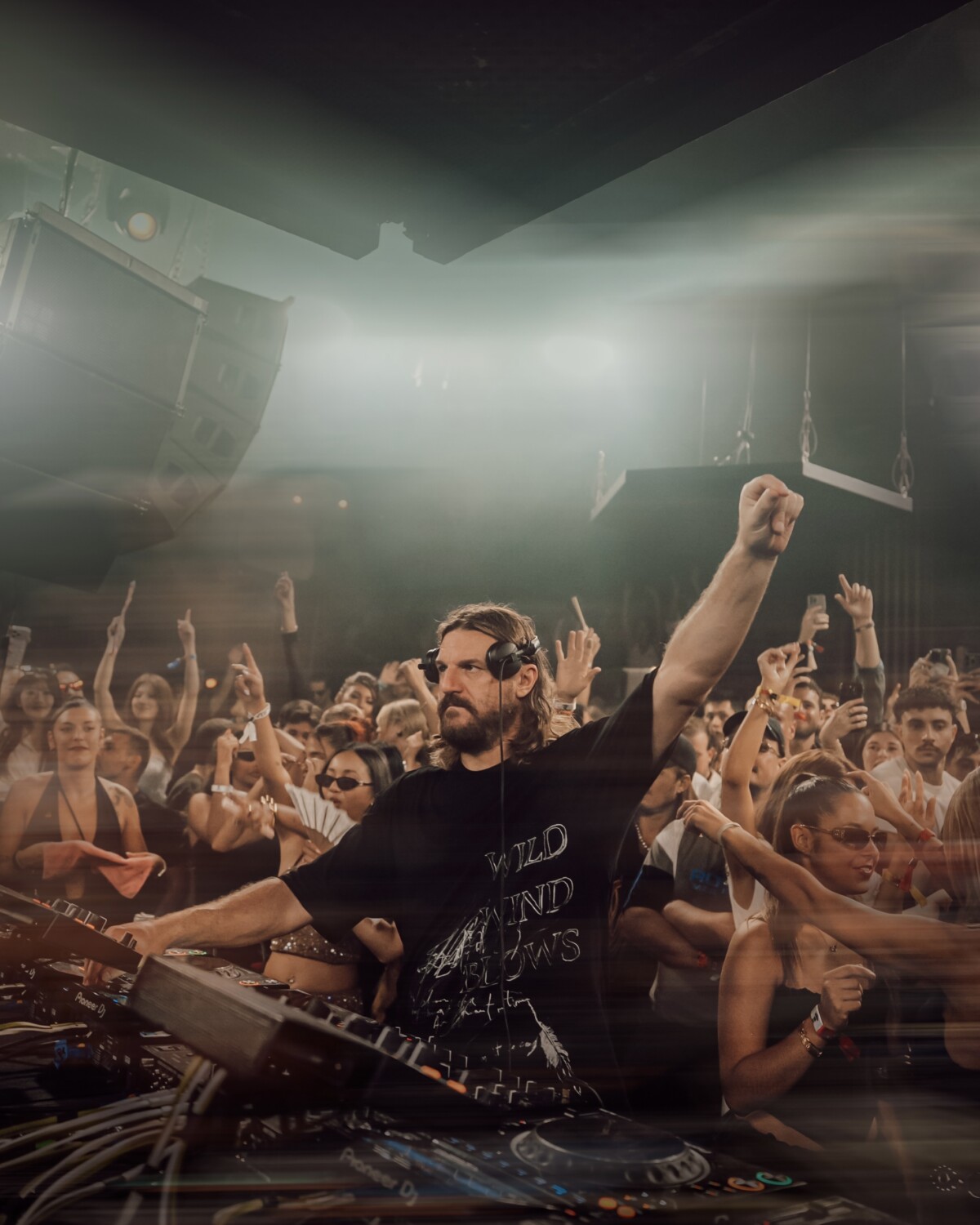
You played Stone Techno once before, in 2024, also as a b2b — with Kameliia. This year you came back with Lea Occhi. What actually felt different about standing on that stage this time — the crowd, the pressure, the whole shape of the set?
The big difference is that in 2024, we played the opening on Sunday. In that sense the whole set was quite different. It was more of a build-up from ambient with the crowd coming in from the beginning, but this year, the floor was already pretty pumping and ready to go.
You limit yourself to five or six tracks per session, something that started as a workaround for a technical limitation early on. You still limit yourself to five or six tracks at a time, even though the technical reason that first imposed that limit has long disappeared. How often our constraints quietly become our philosophy? At what point did that limitation stop feeling imposed and start feeling essential to the way you create?
It was most certainly a workaround when I first started making techno. I got overwhelmed when it came to mixing if I had too much happening, so I would strip back and start playing with existing elements. I realised it was really satisfying to play with existing sounds, rather than introduce more, and that way I can arrange a track really quickly too. After finishing some music that I really liked, it just became my workflow. Initially it was about minimising to keep the mix clean, but it eventually became a process of having as little as possible. I need a kick, toms, riff, hats. Most of the time, that’s enough.
I’d been experimenting with this method for a while, but I feel it really clicked when I made Bais. It was so much fun making something with very little happening beyond the constant movement of a very simple riff.
Your sets are famous for atmospheric storytelling rather than just peak-time noise. Some records seem to reveal more about the person choosing them than about the producer who made them. Is there a track in your collection that feels almost too personal to play unless the moment is exactly right?
Well, one of the tracks I cherish the most is Aztec Mystic’s Knights of the Jaguar, just because it brings back so many fond memories from my formative years (Creamfields UK 2000 in particular). I’ve played it in other cities, but as it’s such a special record that still gets played a lot, I’ve never quite found the right moment to play it in Berlin, aside from a private house party.
Panorama Bar and Berghain seem to draw out different instincts in you. One leans toward openness and flow, the other toward gravity and patience. I’m curious whether you consciously arrive as the same person in both or whether each one quietly invites a different version of you to take over.
I can only compare it to speaking a different language while still keeping your native accent. I’m very grateful to be able to re-explore my musical roots by playing at Panorama Bar. There, I can move around and draw on parts of my musical background that don’t always come through in a techno set. Berghain is more about letting things unfold slowly. I’m the same person in both, but the character of the music naturally brings out a different side.
After years of playing in front of thousands of people, there must be parts of you that have become almost public property. I’m wondering about the opposite. What remains entirely your own?
I value my time in the studio more than ever. It’s my place of solitude where I can experiment and step away from external influences. It’s the one place where I can focus purely on the music itself, before it becomes something to be shared.