Tadao Cern / Black Balloons

Black, clean and monumental: Lithuanian artist Tadao Cern in conversation with Maria Abramenko about his creative process and inspirations.

Black, clean and monumental: Lithuanian artist Tadao Cern in conversation with Maria Abramenko about his creative process and inspirations.

Why black balloons?
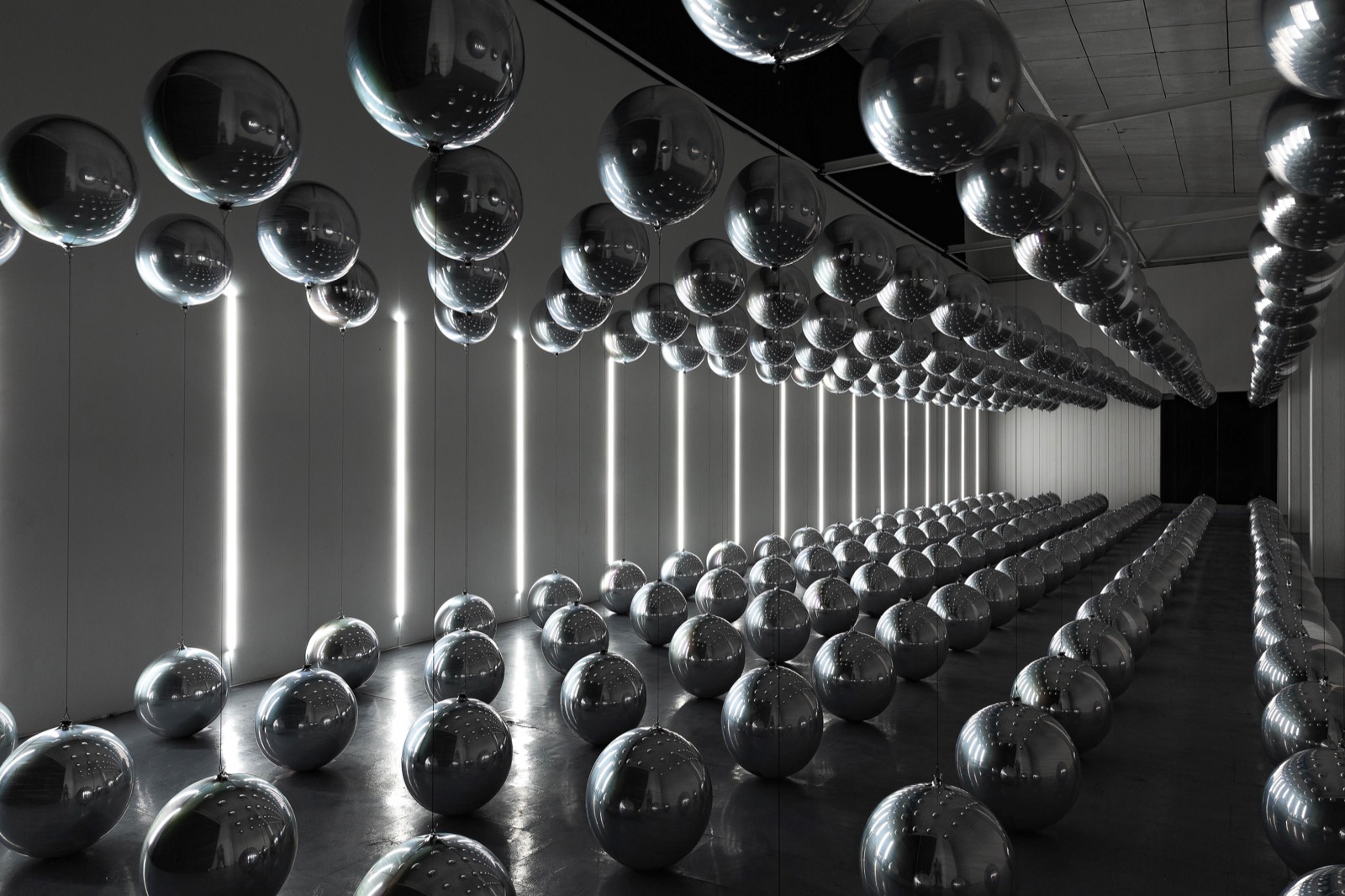
It was a perfect fit for the time and place. I played around with few of them in my studio, without having any expectations and all of a sudden experiment of connecting them together came as a revelation. They became alive. They were holding each other. Lifeless objects started taking care of themselves.
I was always fascinated by our ability(or a flaw) to feel for something that has no feeling in themselves. It’s like we are becoming lost in a maze that we have created ourselves. Compositions started to grow covering more and more aspects that I was interested in: the contradictions between what is real and what is not; personification of lifeless objects; most importantly – nothingness. True meaningless emptiness that I feel every single time looking at that forest of Black Balloons waiting to react to something. No message, no notion… just a fact of them being here and now. Which will become just a reminiscence of an idea once balloons will deflate in a couple of days and the work will become non existent again.


How do you usually operate within the space of an installation?

The space needs to be like a vacuum, that is not adding anything extra to the installation itself. I’m not trying to find or embrace a dialog between the art work and a space, because there is non or it is not my priority in this particular case. Space serves only as a shelter housing an idea for a very short period of time. I’m only looking for something that has as little distractions as possible.

Where did you struggle to install the most?
Outside. Did it once – never doing it again. To create or to maintain an installation indoors is already a big challenge, because there are to many variables and compositions are very fragile. More importantly, no matter where the installation is shown, most of the people who see a round, shiny and inflated object become like dogs without a leash. Everyone is familiar with a notion that art pieces in galleries and museums can not be touched, but for some beautiful reason this is forgotten once a visitor encounters a balloon. I’ve witnessed a destruction of my work just in front of me and once that happens, people wake up from a dream realising what they have done and that they were not in control of their own actions. At first that was very frustrating to me, but later on I started enjoying this, because I understood that I have created not only just a visual concept, but a key to our animalistic and well hidden behaviours. Japan is the only place where I found a very different approach to Black Balloons. I would guess that for cultural reasons these installations there gain different value and that artificial singularity is enjoyed without touching because that would destroy the moment.


Tell us more about your upcoming projects.

It’s always the best if projects speak for themselves. And visual ideas first of all need to be experienced visually. In some cases explanations are not even needed. I would be very happy if I could avoid speaking about my work, because in many cases I’m the same spectator as anyone else in the room. So I try not to have any plans and I see myself only as a tool, not a creator per se. So my opinion about my own work in equal to every single one standing next to me.

You may also like

Love Will Tear Us Apart / Ben Frost

Art&Culture | Spotlight
In October 2025, Istanbul ‘74 presented Love Will Tear Us Apart, a new site-specific installation by Ben Frost that transforms a pair of adjoining rooms into a sound study of fractured communication. Using battered foldback monitors salvaged from years of stage use, Frost creates a sonic environment where signals drift, collide and dissolve across a physical divide. The work examines how individuals strain to reach one another, how intimacy is shaped by misalignment, and how even damaged instruments can carry the residue of longing.

Chloé & Vanessa Beecroft’s Partenope / Naples

Art&Culture | Spotlight
A rare convergence of music, myth, fashion, and performance, Partenope marks the long-awaited world premiere of Ennio Morricone’s only opera, staged at Naples’ iconic Teatro di San Carlo. Directed by Vanessa Beecroft and featuring a historic first collaboration with Chloé under Chemena Kamali, the production unfolds as an ethereal tribute to femininity, ritual and the city of Naples itself, where sound, movement, and costume merge into a singular, immersive experience.

Fantasy Vanishes in Flesh / Ivana Bašić

Art&Culture | Spotlight
Ivana Bašić’s exhibition at Galleria Francesca Minini in Milan remains open only until 12th December. This is the very last chance to experience a show that gathers together archaic materials, hybrid bodies and a profound meditation on transformation and birth.