She Was The Room / Schiaparelli at V&A Museum

Surrealism, craftsmanship, the V&A finally pays attention.

Fashion Becomes Art, the V&A calls it. For Elsa Schiaparelli, there was never that distance to close. A retrospective across the Sainsbury Gallery, 400 objects, ninety years overdue. For the woman whose whimsy was never decorative and surrealism never escapism. What the glass cases contain is not fashion that became art. It is the evidence of what the world looks like when someone refuses to pretend the surface is sufficient. On view until November 8th, 2026.
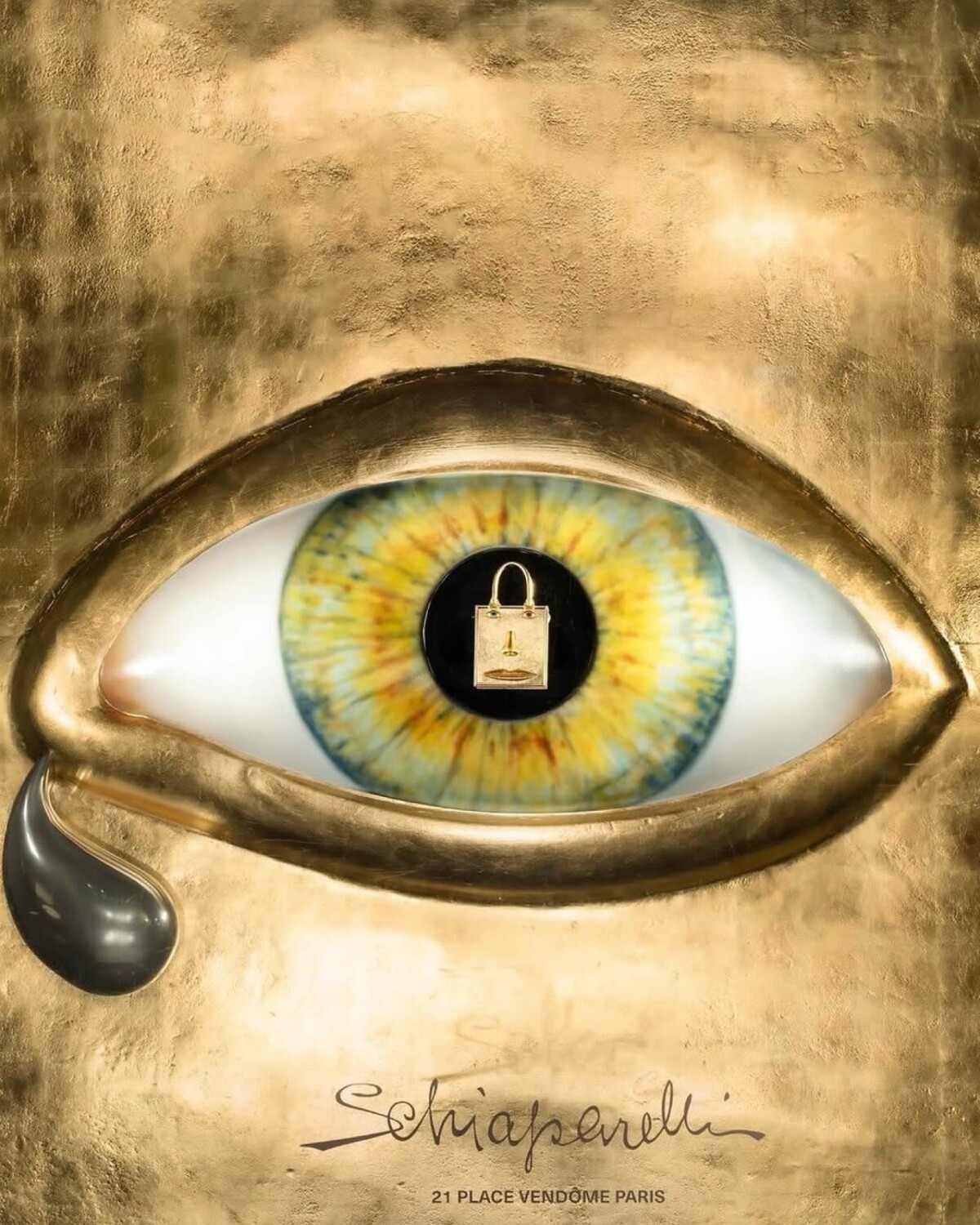
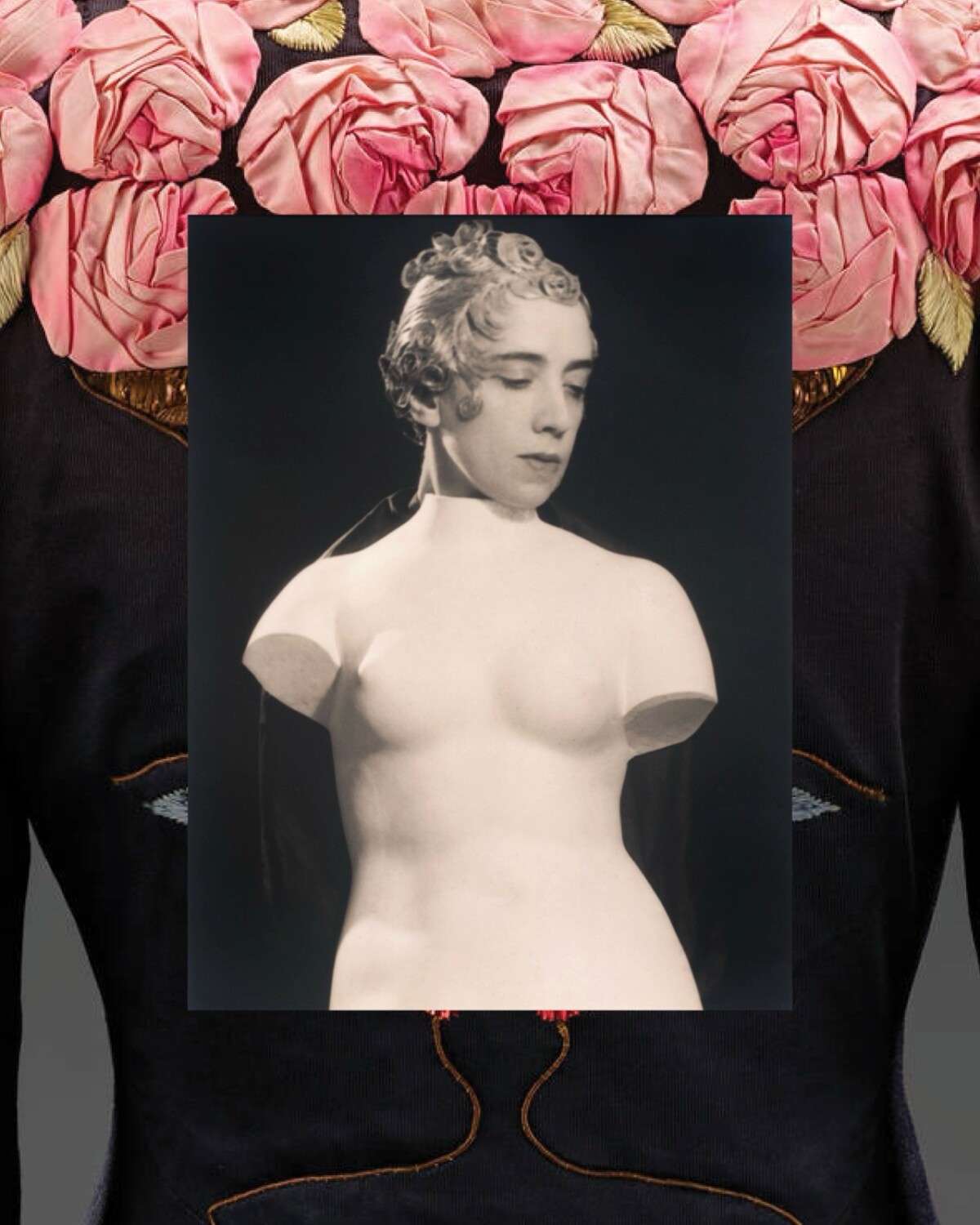
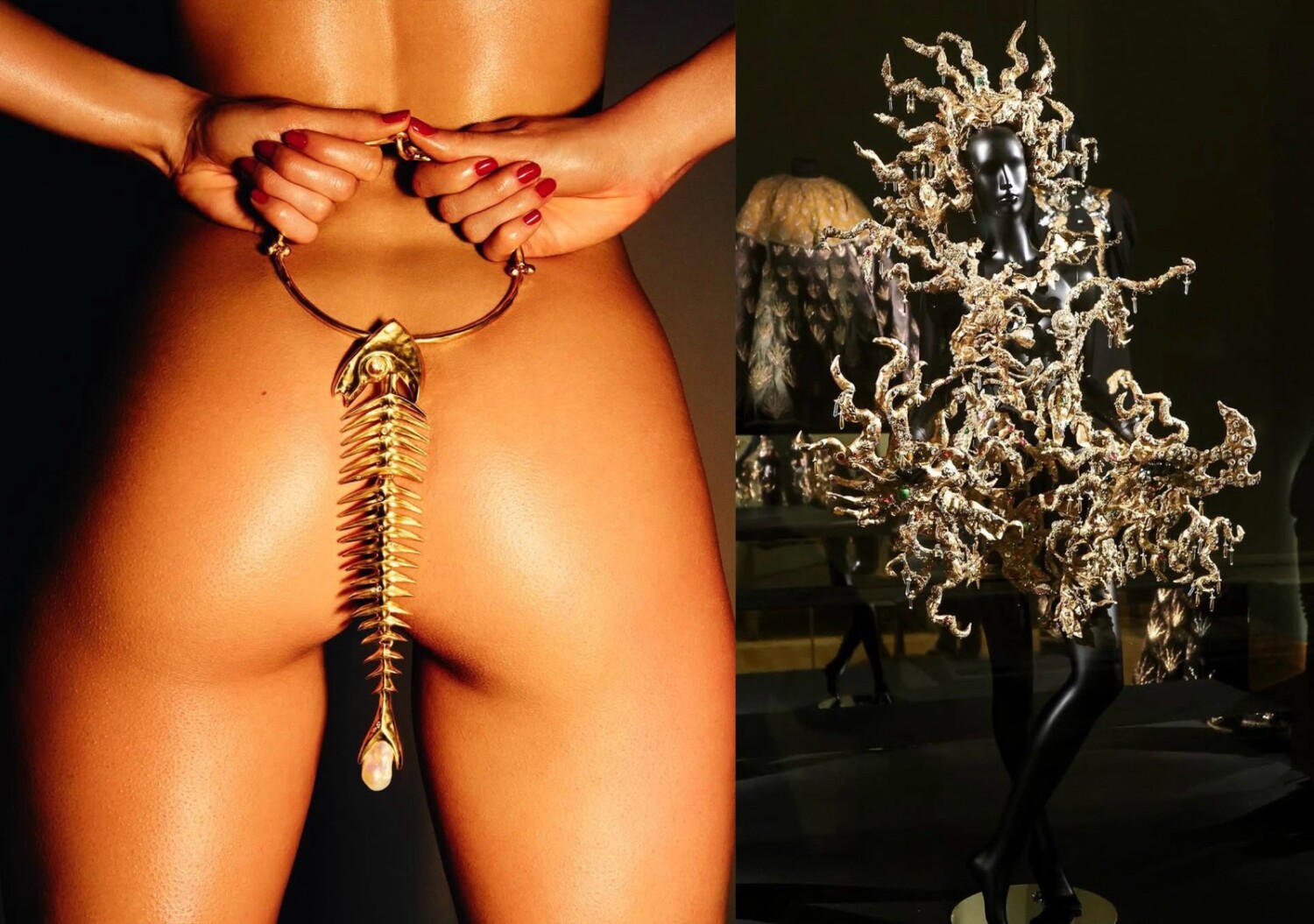
The V&A’s Fashion Becomes Art holds these details in glass cases. Over 400 objects span the Sainsbury gallery, garments, jewelry, perfume bottles, photographs and archival material, making the case, at last in England, for Elsa Schiaparelli legacy not as a designer who made art, but as an artist whose work was in fashion.

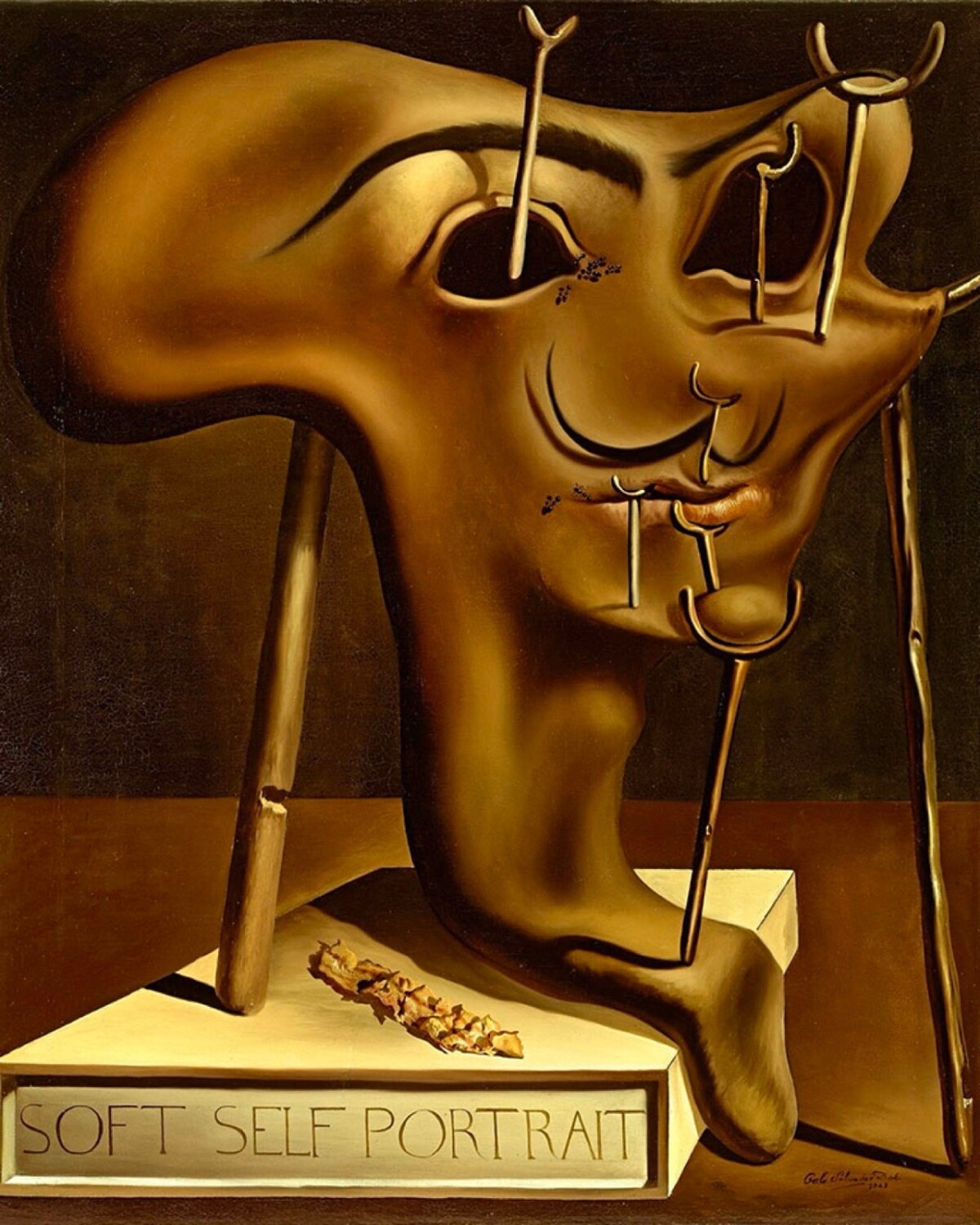
She placed a flower seed in every orifice of her face: nose, mouth, ears. They would bloom, she was certain of it. A bouquet of beauty will replace her face, her youthful desperation for glamour overtaking her need to breathe. Later, Salvador Dali will paint images of a woman with a flower bed for a face, she was his muse. The bust of Mae West in the Shocking perfume has flowers erupting from her head. The bottle was designed by surrealist artist Leonor Fini in 1937. West sent her measurements by post.

Raised in Rome, her father a scholar and orientalist, her mother a Neapolitan aristocrat: Schiaparelli grew up inside wealth and lost it. What money she inherited went to gambling in Monte Carlo. She married a man who abandoned her and their daughter Gogo in New York with nothing. She moved to Paris because the medical care for Gogo’s polio was better there. This is where she built a couture house from a single hand-knitted sweater. The whimsy was never decorative. It was what she built everything else on.

A single mother who navigated poverty and war, whose daughter’s polio diagnosis became the center of her financial life for the majority of her career. Schiaparelli didn’t make art as an escape from the pressures of her life, she made it as an extension of them, the whimsy bearing the load, the surrealism a pursuance of hope. For Schiap, fashion did not simply “become” art, it was only ever art. “Dress designing, incidentally, is to me not a profession but an art.”

In 1922, Schiap fashioned a no-sew dress for her first Parisian party, fit with a matching turban. She noted in her memoir Shocking Life that she had no sewing or design skills, just a natural eye for what looked good. After making quite the commotion at the party, the dress began to unravel. Schiap had to leave the dance floor as her makeshift design was falling apart, but she felt she had accomplished her goal. Get noticed. The next few pieces she made came from the same places of necessity, either to dress her or her friends. Trompe l’oeil, to deceive the eye, was the instinct behind her first works, hand stitched sweaters with optical illusion motifs. A bow stitch with the idea of three dimensions, rendered flat. Outrageous, synonymous with her brand identity long before it was defined, these sweaters marked Schiap as a designer worth paying attention to. One whose designs were not just practical–which, her sportswear and aviation designs most certainly were–but fantastical, imaginative, memorable. A point of excitement and inspiration during a sorrowful time of war and desolation. The surrealist artists she collaborated with were not distinct from her, but within her community. Together they shared drinks and late nights at the Place Vendôme, long conversations about the fascist regime and its dangers. Her fashion designs welcomed whimsy and encouraged play and fantasy during a time of such darkness. As a philanthropist, her efforts caused radical change. She collected thousands of dollars worth of medicine from the Quakers during a trip to New York to bring back to occupied France. She housed the wounded, up to 30 people in each room, in her Parisian mansion. She organised the First Papers of Surrealism in New York alongside Andre Breton and Marcel Duchamp while her Paris salon sat under German administration. The movement’s most significant wartime act of cultural resistance was a woman running a couture house in exile. The histories have not dwelt on this.

Trompe l’oeil was a nudge towards imagination, an urge to close your eyes and imagine a better world on the other side of the carnage.

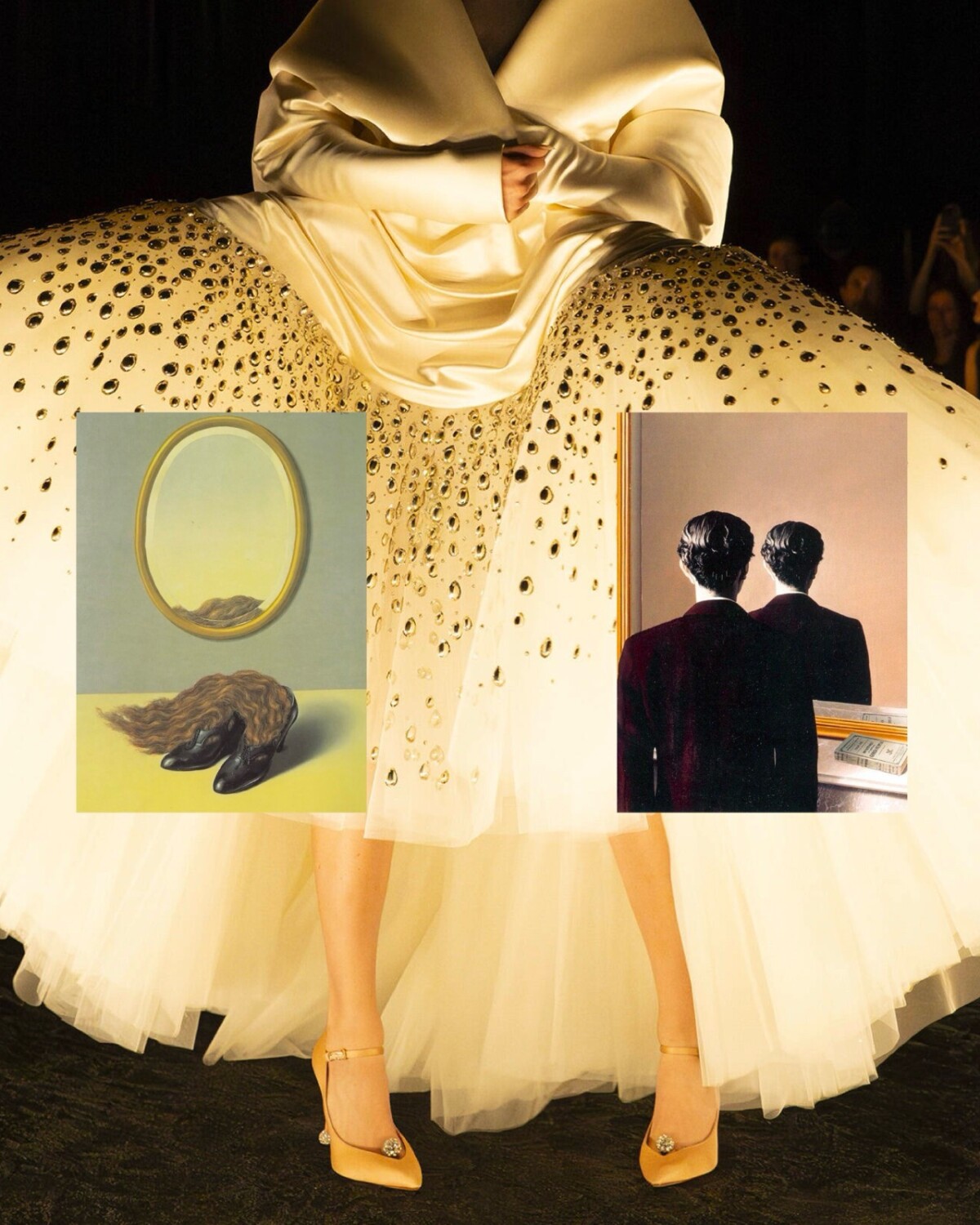
The objects found in the Sainsbury Gallery are arguments made of cloth, thread and glass. In the first rooms, two structured suits stand side by side; precise, architectural, designed for a woman of the world. Nearby, three trompe l’oeil sweaters hang, black and cream, where the dance of handcrafted intricacy and visual illusion began. The Circus Collection is displayed, a crimson jacket with tiny cast metal horses as buttons, a silk jacket printed with rearing horses, its buttons cast gold acrobats mid-tumble. Often regarded as a mechanical tool whose use is purely functional, the Schiaparelli button is instead transformed into something that refuses to be overlooked. She understood that the surrealist act is not reserved for the headline pieces, but it can live within the details, in the buttons.

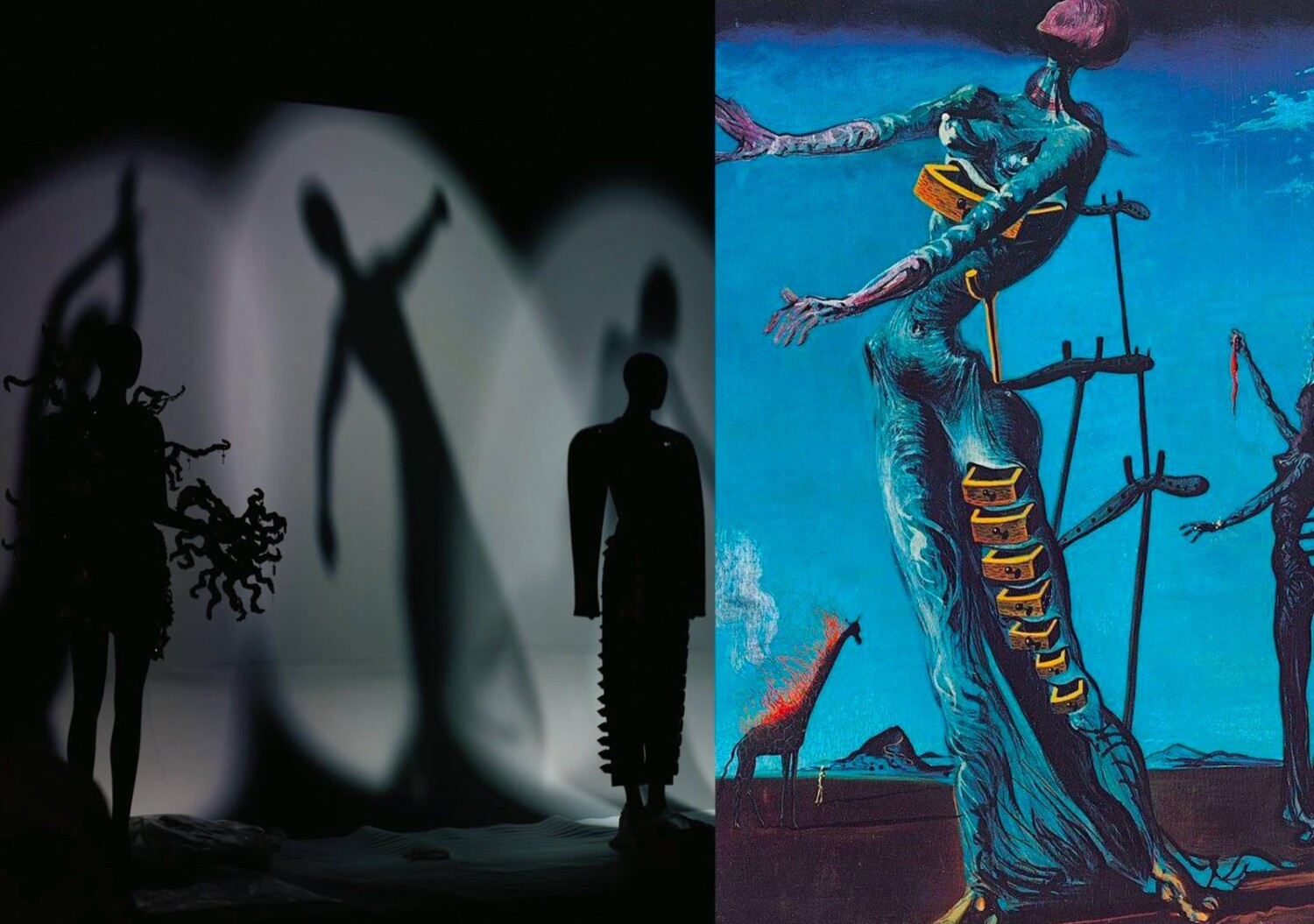
The Lobster Dress has the silhouette familiar to Elsa, with Dali’s lobster creature painted on the skirt between the legs. A surrealist motif of sexuality and bodily transformation, placed symbolically on the gown worn by Wallis Simpson, the year she married the abdicated king of England. The Tears Dress displays fabric that is torn, ripped open, revealing the flesh beneath. Violence made fashionable. Crafted during the time that Europe was tearing itself open while everyone pretended not to notice. Jean Cocteau drew two facial profiles whose illusory shape also depicts a vase of roses onto an evening coat for Schiap. Trompe l’oeil is philosophical in its positioning: the image contains two truths at once, neither cancelling the other. The sculptor Alberto Giacometti crafted buttons for a Marlene Dietrich suit and lamps for the interior of the Parisian salon. Fine art and the applied art of design existed simultaneously in this space.

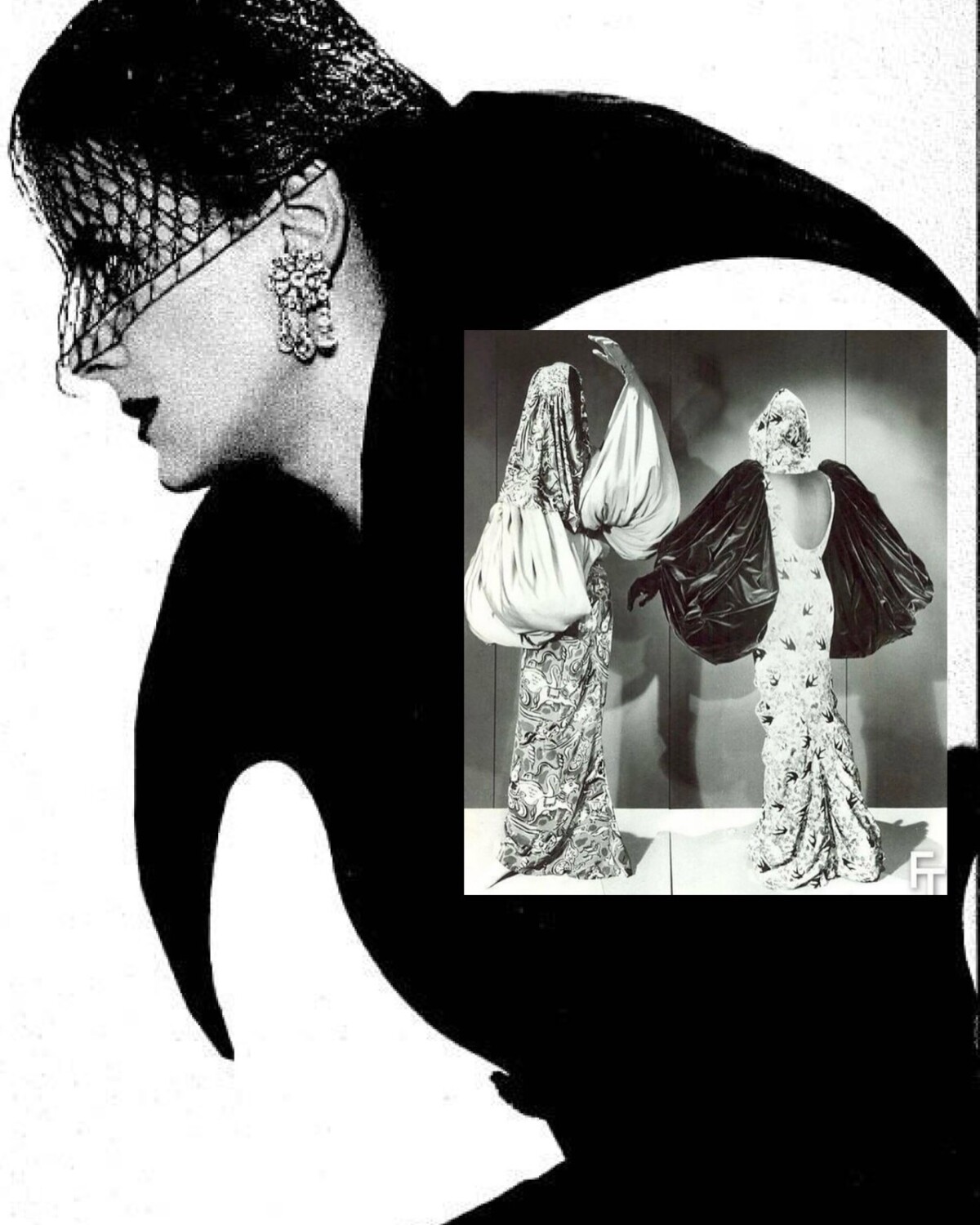
Man Ray photographed her and for years they worked together, inspiring one another. The 1934 image, Schiap wearing an evening gown painted by Jean Dunand, shows her turned slightly away from the lens, hand on hip, eyes gazing beyond the frame. Her shadow on the wall is larger, and darker than she. Man Ray’s surrealist imagery often positioned women as the unconscious navigating the body. In this image of Schiap, she participated without being swallowed whole. Photographed without becoming an object. The surrealist movement thrived on woman muses. Hers was the room the muses came to.

Violence made fashionable. Crafted during the time that Europe was tearing itself open while everyone pretended not to notice.

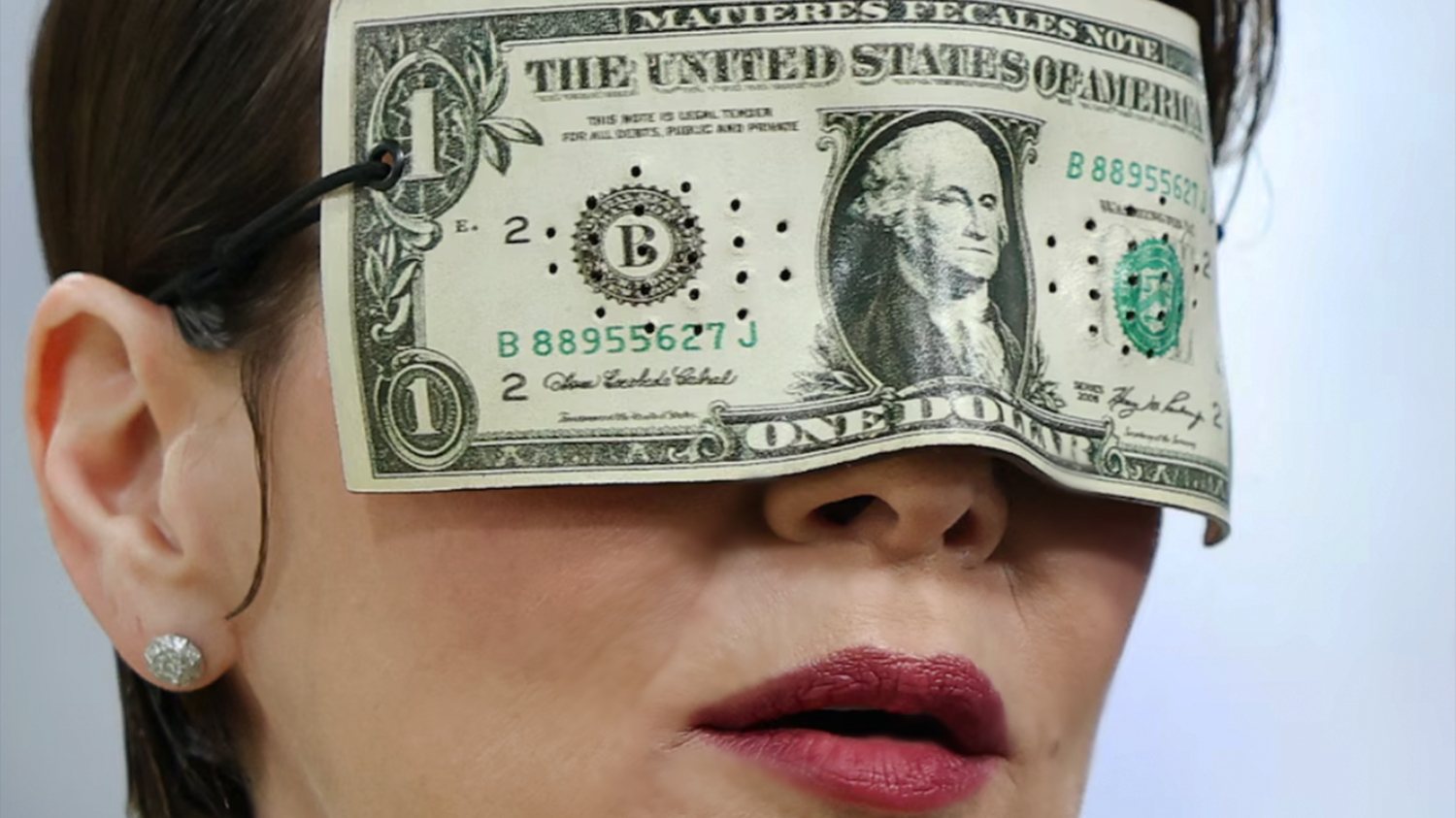
Perfume cases hold their own arguments. The Snuff fragrance, Schiap’s only fragrance made for men, sits displayed in its original illustrated box. Marketed as a gift for the elegant and special man, one with ideas. The bottle is Rene Magritte’s La Trahison des Images, The Treachery of Images, made wearable. A philosophical joke about representation sold as something you could put on your skin, created by a woman whose entire practice was built on the idea that surfaces lie.

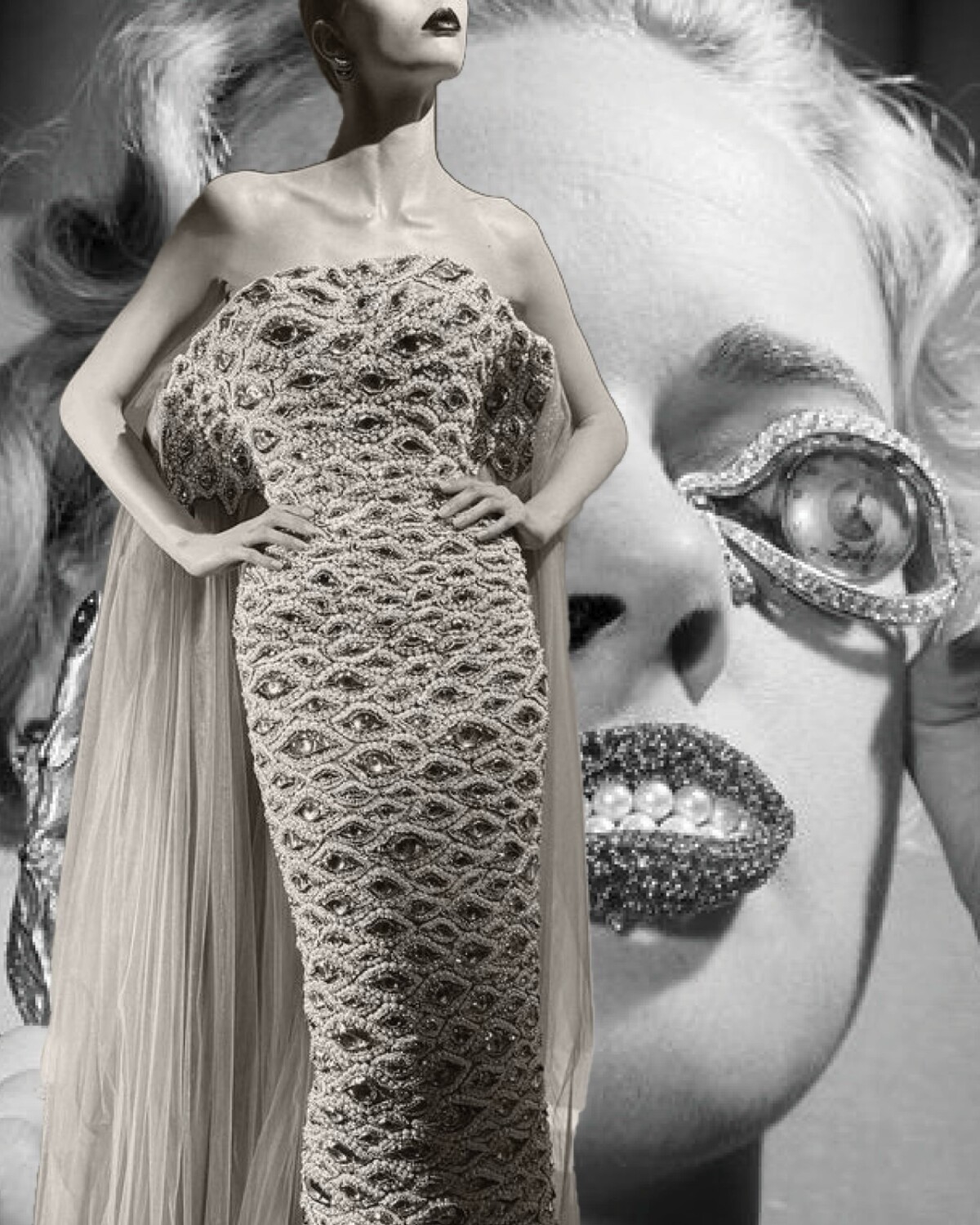
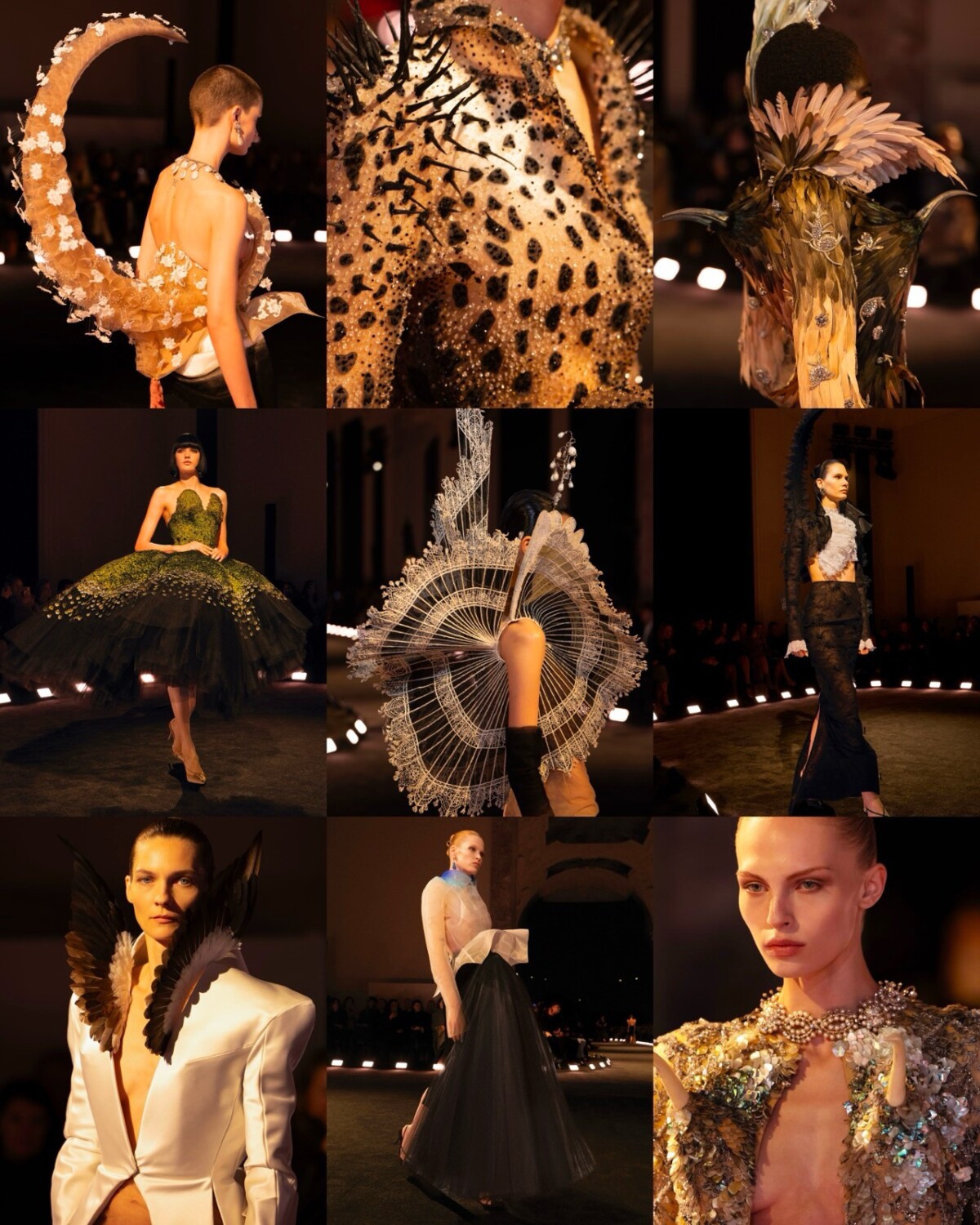
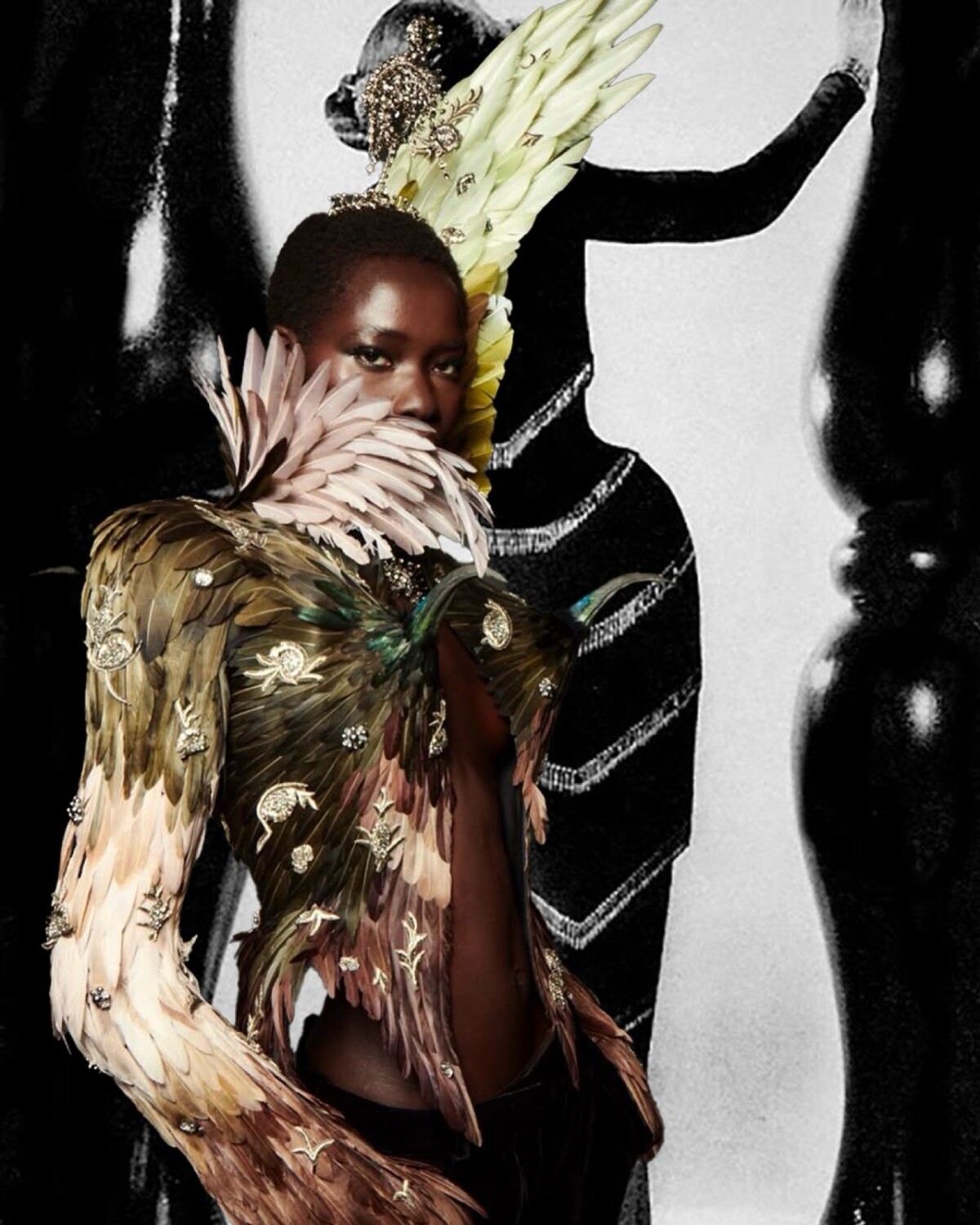
Since 2019, Schiaparelli has been directed by Daniel Roseberry. The V&A has placed his work in the house in the exhibition’s final room, deliberately arguing for continuity. The golden thread, the institution calls it, is real, through his trompe l’oeil breastplates, gilded anatomical jewelry and his insistence that a garment should be worth noting, worth remembering. In the words of Roseberry himself, Schiaparelli’s work was about image making. Now, in the age of social media, he has said, surrealism exists in photorealism. What Roseberry is navigating, and the golden thread that the V&A’s framing cannot fully grasp, is the question of what surrealism means in the age where the primary distribution of images exists on the same platforms that push advertisements between selfies and images of war.

The image that reaches tens of millions of people at once exists differently than the one that lives only within the room where it is worn. Elsa’s lobster dress on Wallis Simpson was only seen by people within that space. Intimate, physical, unrepeatable. Roseberry’s creations that have gone viral are seen everywhere at once, yet nowhere in particular.

What surrealism means in the age where the primary distribution of images exists on the same platforms that push advertisements between selfies and images of war.

This year, the Met Gala theme, “Costume Art,” with “Fashion is Art” being the dress code, the same claim as the V&A on the other side of the Atlantic. Its lead sponsor: Jeff Bezos, whose very fortune was built on the elimination of craftsmanship and individual attention that every hand-stitched Schiaparelli button represents. “Fashion becomes art” these institutions announce, sponsored by the man who built his billions on the opposite proposition. The irony is not incidental, it is the event. A celebration of the handmade underwritten by the very architect of its destruction. Elsa paid her seamstresses above market wages and kept hospital beds reserved for her staff. She understood that the object and the conditions of its creation are not separate. The Met and V&A are still working that out.

Surrealism came to exist in response to the rationalism the world was so desperately clinging onto. The very rationalism created by European civilization was responsible for the ravaging of the innocent; the artists who survived turned to the unconscious, pulling from thinkers like Freud, because the conscious mind had become unreliable, frightening. The dream, the fantasy, the body made strange did not represent an escape, but a response, the only one that felt honest and true to the reality of war. Roseberry’s faux lion head on Kylie Jenner in 2023 pulled from the same instinct. Garments designed to shock.

The intricate craftsmanship of every piece in that gallery is a refusal, of automation, of replication, of the fictional tale that surfaces are sufficient. From the fur-lined ceiling in the perfume room, the hand stitched acrobats on a salmon silk jacket, to the pearls massed on black velvet. During this cultural moment that rewards immediacy, these delicate objects are an act of radical deceleration. What automation cannot replicate and AI cannot generate is not the image of care, but the duration. The time and energy spent on a single button, seam and pearl. Schiap knew this from the beginning. She paid her seamstresses above market wages and offered paid leave long before it was the norm. She kept hospital beds reserved for her staff, even after they worked for her. The care present within Schiaparelli objects and for the person who crafted them were from the same impulse: you cannot make something with that quality of attention while treating the hands who work on it as expendable. Craftsmanship and ethics worked alongside one another, visible in the thread.

In 2026, under Roseberry’s direction, Schiaparelli continues to stand apart. Every creation demands the kind of attention the current infrastructure is designed to prevent. Surfaces have become unreliable politically, technologically and aesthetically. The house has been saying so since Schiap hand knitted a bow into a sweater and made the room look twice.

She Was The Room / Schiaparelli at V&A Museum

Credits:

Words: Isabella Chiocca / @bambina___0
Visual Editor: Elena Murratzu / @elena.murratzu
Location: Victoria and Albert Museum /@vamuseum

You may also like

Residents of the Uncanny Valley

Fashion | Exclusive
Kat Easto drops us into a series of eerie, Lynchian interiors where the familiar becomes unsettling, and every corner hums with disquiet. Drawing from the surreal and the digital age’s numbing overload, this editorial unpacks how constant media consumption leaves us detached, floating between reality and the eerie void. Here, the mundane turns sinister, mirroring our fractured sense of self in a world where nothing quite feels real anymore.

Wanted Witches

Fashion | Exclusive
I am ready to construe the days I coupled with dust in the shadow of a stone. Brightness ascends my thighs. I am lost, I am lost, in the robes of all this light. An incanted story by Laurie Basset.

Too cool

Fashion | Exclusive
I’ll leave you some little notes under the door, under your scented pillow, near where your face rests. Hidden in the endless folds of your bed. And when you’re alone, take them, they are proof that everything exist and that’s not a simply dreamlike vision. An onirical fashion story shot by Julien Gozlan and Valentin Chenaille.