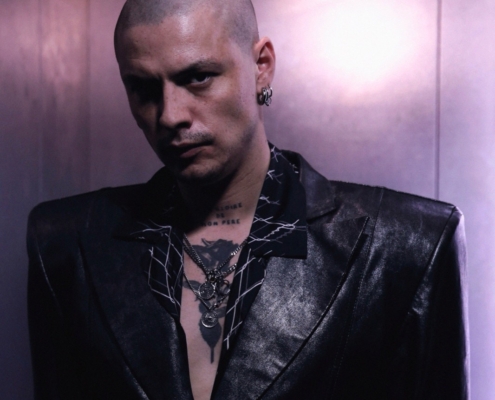
Your music is strongly rooted in Detroit techno and the ’90s/00s era. What draws you to those sounds, and how do you make them your own?
What draws me to Detroit techno and the ’90s/00s era is the rawness, the groove, and the emotional depth those sounds carry. There’s something timeless and powerful in the way the music was produced back then and less polished, but full of character and intention. It wasn’t about trends; it was about expressing something real. I try to honor that spirit by incorporating those influences into my sound while keeping it fresh and personal. I like to blend classic elements, like analog textures, rolling basslines, and hypnotic rhythms, of course with my own modern touch, whether that’s through arrangement, sound design, or the emotional direction I want the track to take. It’s about building a bridge between eras and making something that feels familiar yet new, rooted in tradition but speaking in my own voice.
Your recent Boiler Room set marked a personal turning point — playing only your own productions in front of 7,000 souls. Did performing a fully self- produced set change how you approach DJing or music production?
That Boiler Room set was definitely a turning point for me, not just professionally, but emotionally too. Playing only my own productions in front of so many people was both empowering and vulnerable. It felt like I was sharing a very raw and honest part of myself with the crowd. It pushed me to look at my music differently. I realized that everything I need is already in my own sound.
That mindset has influenced the way I approach both DJing and production now. I focus more on building a cohesive story with my own identity at the center. It gave me confidence to trust my instincts and lean deeper into my creative vision.
In a world obsessed with edits, remixes, and sonic collage, there’s something radically vulnerable about playing only your own work. Did you feel exposed — or finally in control?
I actually felt both exposed and completely in control. It was a mix of vulnerability and empowerment. There’s no safety net when you’re only playing your own music. You’re not hiding behind crowd-pleasers or familiar tracks! You’re fully out there, sharing your own voice, your own energy, your own imperfections. But at the same time, there was a powerful sense of ownership. Every sound that came through those speakers was mine, and that gave me a deeper connection to the moment. It felt like I was finally shaping the experience from start to finish, and that’s a very freeing feeling. It reminded me why I started doing this in the first place, not to copy trends, but to say something real.
Has there been a moment where someone’s response to your music really stuck with you?
Yes, there have been a few moments that really stayed with me, but one in particular stands out. After a set, someone came up to me and told me that one of my tracks made them cry, not out of sadness, but because it reminded them of a memory they’d forgotten. It really hit me. It’s easy to get caught up in the technical side of things, but that moment reminded me of the emotional power music can have. When something you create reaches someone on such a deep, human level, it gives your work a whole new meaning.
It’s moments like that which keep me inspired and grounded.
Your sound hits with precision but bleeds with tension – How do you metabolize audience reactions? Are you ever surprised by what people hear in your tracks?
Absolutely. I think the most beautiful part of releasing music is realizing that once it’s out there, it doesn’t fully belong to you anymore. People bring their own emotions, memories, and stories to the music, and sometimes what they feel or hear in a track is totally different from what I intended and I love that. When I’m performing, I definitely absorb the audience’s energy. I read their reactions not just through movement, but through the atmosphere, how the room breathes with the music. That energy feeds back into me, and it shapes how I deliver the next moment. What surprises me the most is when people pick up on subtle emotions, like the tension, the melancholy, or even a sense of hope buried deep in a groove. There’s so much room for feeling. That connection is everything.
Festivals are massive, but intimate clubs have their own energy. How do you shift your approach when playing such different spaces? Does the intimacy of a smaller venue inspire a different side of your creativity?
Absolutely!! The space completely changes the dynamic, and I love adapting to that. Festivals are powerful because of the scale. You feel the weight of thousands of people moving together, and there’s this rush of energy that pushes you to go big, be bold, and take risks that match the intensity of the setting. But intimate clubs have a special kind of magic. You can really lock in with the crowd, feel their energy up close, and take them on a deeper, more personal journey. In smaller venues, I tend to play more detailed, emotional, and hypnotic sets. I’m more spontaneous, and I feel free to dig into the more vulnerable or experimental sides of my sound.
That intimacy inspires me to slow down, breathe with the room, and build something truly unique in the moment. It’s not just about the tracks, it’s about the subtle tension, the eye contact, the shared silence between drops. It’s where I often feel most connected.
You’re always traveling—how do you feel the crowd’s energy shifts between cities like Berlin, Buenos Aires, Detroit, and Amsterdam? Do you notice cultural differences in how people respond to your music?
Definitely, each city has its own pulse, and you can really feel that as a performer. Each place teaches me something new. It’s amazing how the same music can be received so differently depending on the cultural context, but that’s what keeps it exciting. For example as you mentioned Berlin, this city has this deep-rooted connection to techno, so the crowds there are often very tuned in, they appreciate subtlety, long transitions, tension. There’s a kind of quiet intensity in the way they listen and respond. But everywhere is different and every city has its own magic!
How do you manage the constant pressure of touring and creating music without burning out? What keeps you motivated, and what do you do when the exhaustion hits?
It’s not always easy. Touring, creating, staying connected, it can be intense, and there are definitely moments where the exhaustion creeps in. What’s helped me is learning to listen to myself, to know when I need to slow down and protect my energy. Rest is just as important as the work. I stay motivated because I genuinely love what I do. The feeling I get from connecting with people through music, the rush of a set, or the moment a new track finally clicks, those are the things that keep me going. But I’ve also realized that inspiration doesn’t always come from the studio or the stage. Sometimes, I need space to live, reflect, and just be.
When burnout hits, I try to step away without guilt, go back to the simple things that ground me. Walks, silence, nature, time with people I trust. That balance is what keeps me going in the long run. It’s a journey, and I’m still learning how to navigate it.