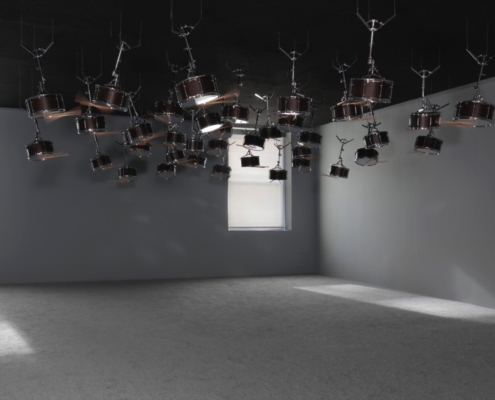
Loscil / Meditations on time perception

Maria Abramenko in conversation with Loscil, Canadian artist and composer. Talking about art, music and the connection between the two.

Loscil is the project of Vancouver based composer Scott Morgan who explores the marriage of electronic production and acoustic instrumentation to create stark landscapes that are evocative, earthly, anything but abstract, and so much more than merely ‘ambient’. In conversation with Maria Abramenko, talking about art, music and the connection between the two.

We all know you as an outstanding composer, I would like to ask you about your art, personally I have noticed it through your Instagram feed, can you tell me how and when did you start?

I’m not sure I can trace it back to one moment. I find photography, especially landscape and architectural photography, elicits very similar underlying expressiveness to music and sound for me. The collecting of field recordings and photographs are naturally complimentary endeavours. There is something fundamentally intoxicating about how both media meddle with your perception of time. They both disconnect you from “real time”. Photography, of course, is more about brief moments when the shutter is open and sound recording is more about longer passages or recording but neither one feels like the “real time” that we experience day-to-day which is a big part of their meditative allure to me.

Is there a connection in your sound and vision?

Absolutely. For the past 5 or 6 years my live performances have been audio-visual. I am kind of fascinated with the history of “visual music” – artists like Oskar Fischinger, Norman McLaren, John/James Whitney, Stan Brakhage, etc. I think there is something incredibly pleasing about the treatment of visuals as an extension of music. At times in counterpoint, at times in sync but ultimately, acting as another dimension to the experience. I approach both sound and image in a very similar fashion and seek a kind of synergy. Naturally, I bring the same “musical eye” to my photography.

Would you call your Instagram page a diary or a gallery?

Perhaps more of a gallery. I definitely have internal “rules” for what I allow myself to put there in terms of photography. I edit and curate myself I suppose and tend to follow mostly creative driven sites on music, photography, etc. For me, the value of Instagram and other social platforms is to send and receive inspiration rather than to act as portholes into others’ personal lives which I still find unsettling.

Do you consider yourself as an artist or musician?

I am certainly more comfortable calling myself a musician as that’s something I have more training in and have made a profession out of but I don’t like most categories and if I can straddle more than one, I feel more myself.

What are you working on these days?

I just released a photo booklet with music called Faults, Coats, Lines. This was a project I started last year and shelved as I was busy with other things. Being locked in due to the pandemic gave me some time to revive it so I decided to release it May 1. I have another music project on the go but I am working slow these days. Giving myself time.

Listen to Soundscapes vol.20, a playlist curated by Loscil

You may also like

The Brief Unseen / Anri Sala

Art&Culture | Interview
For Sala, the experience of entering a world that had once been inaccessible became inseparable from the question of how we perceive and understand it. Growing up in Albania under communism and later arriving in Paris, he encountered a plethora of unfamiliar artistic forms, as well as an entirely different set of lenses through which to make sense of the world. That tension between the known and the newly imaginable continues to run through his practice. Across sound, image, language, material and time, Sala explores the spaces between perception and intuition, intention and accident, the tangible and the immaterial. His works ask us to question and dissolve the reality of what we see and hear, and what might exist in the interval between them.
Did Youth Culture End in 2000? / Mark Leckey

Music | Interview
From acid house to SoundCloud, religion, archives and AI, this conversation asks a simple question: Where does youth culture exist when everything is already online? Read our cover conversation with Turner Prize-winning artist Mark Leckey.

Into The Night / Barbara Hoogeweegen

Art&Culture | Spotlight
London, a 19th-century townhouse, ambiguity and abstraction. The artist presents her exhibition as an escape from reality, or perhaps as a gateway to the forget land of emotion. Everything is allowed: a lucid dream immersed in half-light. On view until September 23 ((open daily 12 – 6pm or by appointment).