Shostakovich’s 5th Played Backwards in a Concrete Silo / Sheet Noise

A Musical Analysis Stemming from the LP’s Visual References

Sheetnoise’s debut as a cultural detonator between Soviet cacophonies, possessions, alien miscarriages and concrete chambers.

When I prepared myself to listen to Sheetnoise’s debut LP, Shostakovich’s 5th Played Backwards in a Concrete Silo, released on 5 December 2025, I immediately realised that what was unfolding before my ears resisted any form of categorisation. It was not jungle, nor was it noise in the orthodox sense, nor ambient, nor strictly industrial, yet it seemed to incorporate and subsequently obliterate each of these genres in a single convulsive gesture. The LP operates like a sonic seizure in which pre-existing categories are violently pulled apart and stitched together in a new habitual disorder. I had never heard anything quite like it. The experience was one of complete shock, an oscillation between opposing emotional states. The ethereal implodes into the abrasive, the soothing morphs into the diabolical, and suspended atmospheres invert themselves into a lucid, persistent anxiety. This tension, relentless and unbroken, forms the backbone of the EP. It was precisely to understand this tension and to internalise it more deeply that I felt compelled to interrogate the constellation of images, references and allusions embedded in the title and the accompanying artworks.

The unavoidable point of departure is Shostakovich himself. He appears in the title not merely as a key composer, but as a kind of detonator, a spark that ignites an entire ritual machinery. His 5th Symphony, articulated across the four movements Moderato, Allegretto, Largo and Moderato Allegro, is reimagined here as a reversed tape. The very thought of such an inversion conjures associations with ritualistic inversions of sacred texts, particularly the way in which music played backwards has been framed in occult lore as an act of desecration, subversion and the opening of metaphysical doorways. The concrete silo, invoked explicitly in the title, is not merely a setting but a symbolic amplifier. It represents industrial ruin, the material memory of labour and erosion, a site where resonance becomes abrasive by necessity; the music thus imagines itself as echoing through a brutalist womb, forged from cement, pressure and abandonment.

Yet Shostakovich appears here not only through brute force, through the sheer tectonic power of his climaxes, but also through the literary and philosophical strata that shaped his compositional thought. The young Shostakovich, irreverent, provocative and often antagonistic to Soviet cultural orthodoxy, drew inspiration for the 5th Symphony from a poem by Pushkin commonly translated as Rebirth. The poem describes the relationship between the true artist and the barbaric hand that paints over the original work. 

The violence that permeates Possession immediately brought me back to another of Shostakovich’s works, namely Lady Macbeth of Mtsensk, recently staged at La Scala in Milan. The connection between the two is not at all arbitrary. Both works revolve around the metaphor of women seeking ideal love then spiralling into murder. Katerina Izmailovna, the protagonist of the opera, is married to a wealthy merchant in Tsarist Russia and falls into the entanglement of a manipulative affair with Sergei, a servant. Overwhelmed by love and by the oppressive boredom of her domestic life, she kills first her father in law and then her husband in order to protect the freedom given by the clandestine relationship. The ending is tragically inevitable. Once betrayed by Sergei, who courts other prisoners, Katerina attempts to murder a rival during their deportation to Siberia. They plunge together into an icy river and die in the same fall. In Zulawski’s film, Mark and Anna meet an analogous fate. After injuring one another both physically and emotionally and after transforming themselves into colliding forces, they die in each other’s arms. Their death, however, is not a release: the creature survives, the humanoid double keeps on walking the earth. 

These two references to Shostakovich and Zulawski shaped my entire sensory perception of the LP. On one side lies the orchestral cacophony, the emotional brutality, the saturated climaxes of Lady Macbeth and the suspended aching moments of the 5th Symphony. On the other side lies the feverish corporeality of Zulawski, the grotesque transformations, the duplication of bodies and the portrayal of love as a force that veers towards horror.

Shostakovich was undoubtedly a singular genius. Lady Macbeth was composed in a matter of months. An entire booklet and orchestral score were created at an impossible pace, without hesitation. Within the opera lie passages of extraordinary sexual cacophony, particularly the scene depicting the attempted rape of a maid. It represents one of the most technically and emotionally complex moments of the work, unfolding as a total confusion of sound, a disturbing energy driven forward by the near orgiastic vocalisations of the soprano. After listening to Sheetnoise in the immediate aftermath of revisiting Lady Macbeth, I recognised a similar intention. Both works strive to generate sound as collision, as excess, as emotional overload that spills over into physical sensation.

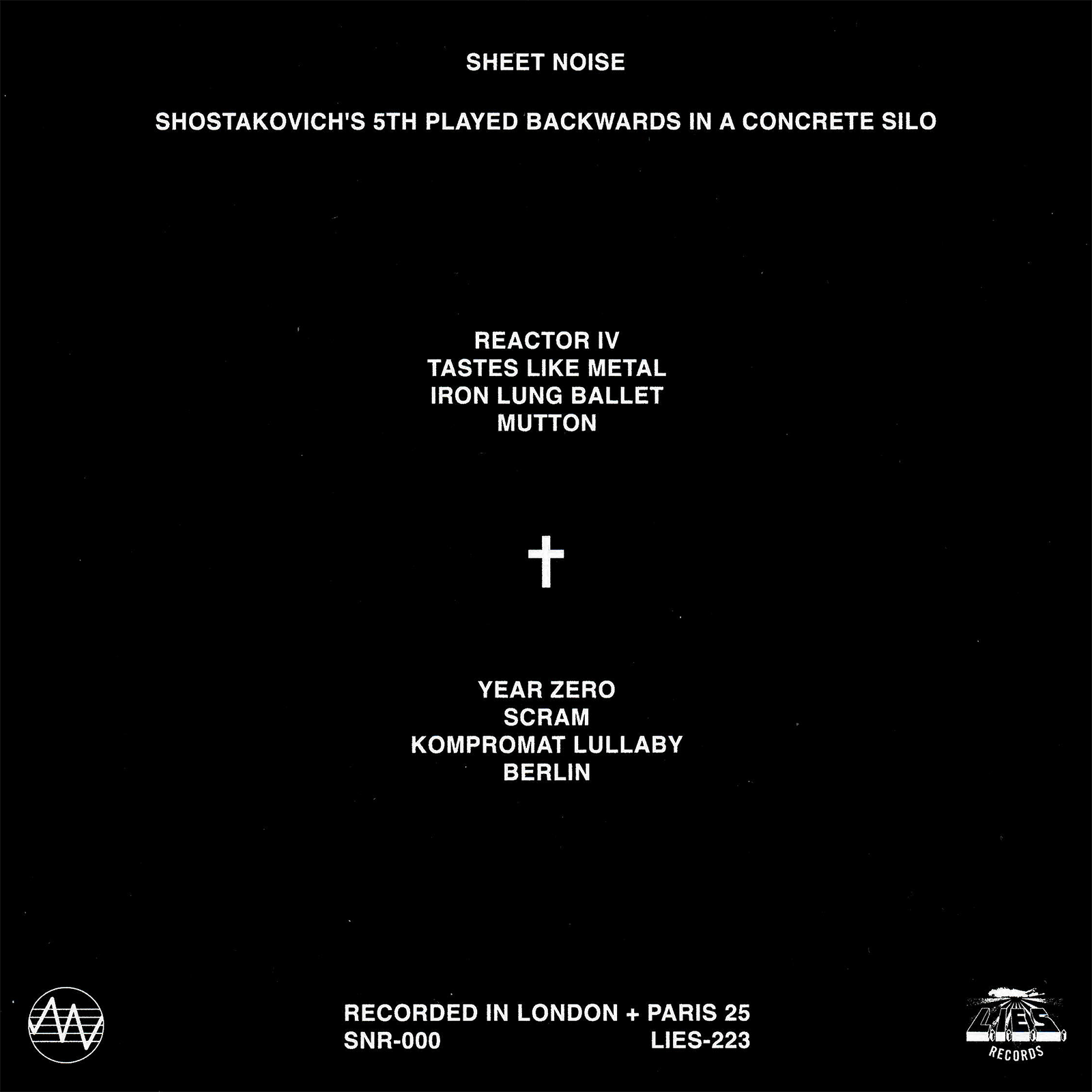
Across the LP’s arc, each track unfolds like a chamber in an abandoned industrial complex, beginning with Reactor V, an ethereal, gaseous exhalation in which sound seems to condense and evaporate at once, as though the walls themselves were breathing; this vapour solidifies violently in Tastes Like Metal, where one feels trapped inside a trembling steel chamber, drilled, rattled, motorised, until a single, ill-omened chord strikes like a warning siren, followed by reverberations that stretch into a kind of mechanical lament, wind-driven oscillations making the metal itself weep. Iron Lung Bullet sharpens this tension as violin chords cut through a background distortion that swells like a black hole swallowing the remnants of melody, the poetry of the piece slowly suffocated by a monstrous presence hiding just behind the mix; breathing apparatus clicks into rhythm, the machine is working, and the opening sound, unmistakably a bullet being fired, sets the track on a fatal trajectory, its passage through air rendered with chilling clarity before everything collapses into the silence of its unconsolable impact. 

Shostakovich’s 5th Played Backwards in a Concrete Silo / Sheet Noise

Credits

Artist: Sheet Noise / @sheetnoise
Words: Giulia Piceni / @giuliaapiceni
Editor: Maria Abramenko / @mariabramenko
Junior Editor: Annalisa Fabbrucci / @annalisa_fabbrucci

You may also like

Chaney Diao / Boundless art

Art&Culture | Interview
We dive into a flow without genres and classifications. Different artistic expressions are mixed and blended to create meaningful performance and sensory experiences. The body as protagonist is expressed without limits, provocative and fetishistic themes are explored to make us reflect and overcome all restrictions.

Arthur Coquille-Hopfner / A Brief Study of Obsolete Mechanics

Art&Culture | Spotlight
Arthur Coquille-Hopfner’s exhibition Petite Étude de la Mécanique Obsolète is the fifth show in 229 Lab and the artist's solo debut.

BabyNymph / Nemesis

Music | Soundscapes
A talk with BabyNymph, a Russian producer and DJ based in Athens, on self-expression, bravery, originality, and pride. The need to enhance respect and equality is more topical than ever. June is just another excuse to celebrate the greatness of freedom. Happy Pride Month!